Builder Jak (Jack)
Gender: Gelding
Breed: Thoroughbred
|
Age: 4
Height: 15.3
|
Offered by New Beginnings Thoroughbreds, Inc
Serenity At Last Farm - Ringoes, NJ, 10 Manners Road, Ringoes, NJ 08551
Photos
Click on photo to view larger image
Suitability and Training
Best career/placement option for repurposing Builder Jak (Jack):
Competition
Recreation/Pleasure Riding
More about career/placement options:
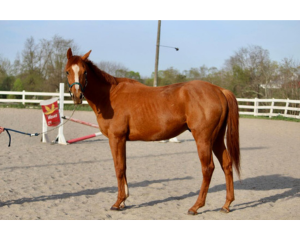
This 15.3-hand bay gelding retired sound from racing for being too slow. He is super cute with a sweet face and big heart. Jack is getting some down time after arriving to our program, and seems to be a nice mover and an easy boy to handle. He has had three post track rides, and has been willing and level headed. Cribs but it is controlled with a collar.
Close X
Builder Jak (Jack) is located at Serenity At Last Farm - Ringoes, NJ, 10 Manners Road, Ringoes, NJ 08551.
Total acreage dedicated specifically to the horses: 20
Our organization has use of the following at this facility:
Structures/Barns: 1 Run-in sheds: 7
Pastures: 7 Paddocks/Pens/Turnout Areas: 2
Uncovered Outdoor Rings: 2 Covered Outdoor Rings: 0
Indoor Rings: 1
Horses have assigned stalls in the structure(s) or exclusively assigned shelter locations where they are separated from other horses with a barrier.
Horses are stalled for 1-3; hours per day, on average.
The following describes the pastures at this facility:
A dedicated staff person(s) is responsible for pasture management
All pastures are fenced to prevent escape or injury
Fencing checks, such as broken or missing planks, loose fence posts, exposed or loose nails, detached wires, etc., are done regularly
Pastures have natural protection for equines (i.e., trees)
Pastures have man-made protection for equines (i.e., shelters)
The following describes the turnout areas other than pastures at this facility:
A dedicated staff person(s) is responsible for the maintenance of turnout areas
All turnout areas are fenced to prevent escape or injury
Electric fencing is used; electric wires or tape fence are visibly marked
Turnout areas have man-made protection for equines (i.e., shelters)
Fencing checks, such as broken or missing planks, loose fence posts, exposed or loose nails, detached wires, etc., are done regularly
How many hours per day, on average, are horses turned out:
Equines are out 9 to 15 hours per day
Equines are out 16+ hours per day
Equines are out 24/7
Equines are out 24/7 except they are brought in to feed
Equines are out 24/7 except they are brought in if there is inclement weather
Equines are out 24/7 except when they are being trained
The following items are consistent with our feed management plan and practices:
Equines are provided with individualized feeding plans, including supplements, according to the equine's age, breed/type, condition, size, work level and any health issues, consisting of nutritious food provided in sufficient quantity and access to adequate natural forage, or be fed daily, or as recommended by the organization's veterinarian
Feed plans are determined in consultation with a veterinarian
Equines are fed grain in individual stalls
Equines are fed grain in groups
Staff and/or volunteers are trained in proper feed measurements and protocols and observed periodically to ensure they are feeding correctly
The feed chart is centrally located and updated as needed
The area(s) where hay, feed, grain, and supplements are stored are kept clean, free of debris and chemicals, and protected from weather and other animals in rodent-proof and mold-proof containers and grain bins
Feed, supplements and hay types are clearly labeled
Water sources, i.e., buckets, troughs, automatic waterers, etc. are kept clean, free of contaminants, debris and chemicals, protected from weather and other animals, and be positioned or affixed to minimize spillage.
Medications are kept in a secure area
Clean, potable water is available at all times for all equines
Hoof Care: How often is hoof care provided for each horse? Every 4-8 weeks and when an issue arises
Dental Care: How often is dental care provided for each horse? Annually and when an issue arises
Horse checks: How often are horses visually and physically checked by personnel at the facility? Every day or 6 days a week
Our organization has the following parasite and fly/insect control protocols in place, including remedies used to control flies and insects:
Fly/Insect Control Remedies:
Premise Sprays/Insecticides
Fly Spray Repellent
Fly Masks
Fly Sheets
Fans
Last Updated: 2025-09-21
Close X
Rehoming
Our organization has the following re-homing (adoption/purchase) policies and procedures in place:
All potential adopters/purchasers complete a written contract which constitutes the agreement between our organization and the new owner
Our organization will only re-home an equine to a location where another equine resides
Potential adopters/purchasers must visit our organization and be observed with the equine on site
The distance of a potential adopter/purchaser's home from our facility is a consideration for when re-homing an equine
The agreement reflects that any individual or organization in possession of the equine as of the date of the agreement and any time thereafter is bound to not sell the equine at auction for slaughter or allow the equine to be sold, transferred, released, or otherwise placed into possession of any person or organization that will cause or allow the equine to be sold at auction for slaughter.
The agreement states that should the adopter decide to re-home the equine, our organization must be notified of the name, address, and telephone number of any individual or organization intending to take possession of the equine for any reason prior to the equine being placed into the possession of such individual or organization.
The agreement states that the terms of our organization's agreement will be binding on any future individual or organization taking and/or in possession of the equine for any reason.
The agreement states that re-homed equines cannot be bred
The agreement states that if there is any breach of contract the equine must be returned to our organization
The agreement states that our organization reserves the right to make unannounced visits
The agreement states that our organization reserves the right to make scheduled visits
The agreement states that adopters/purchasers can return an equine to our organization free of charge
Our organization microchips all equines that are not already microchipped before the adoption and/or transfer of the equine if the organization has the authority to microchip the equine.
Our organization requires references from the following:
Veterinarian
Farrier
Personal/Other
Transfer of ownership occurs:
After one year
The average equine re-homing (adoption/purchase) fee received by your organization:
Over $1,500
View Re-homing Agreement
Last Updated: 2025-09-21
Close X
New Beginnings Thoroughbreds, Inc
10 Manners Road
Ringoes NJ 08551
732-406-4036
Last Updated
Public Charity
Our Mission/How we are involved with horses:
The mission of New Beginnings Thoroughbreds is to retrain and secure well-qualified and loving adoptive homes for off the track thoroughbreds.
Primary Focus involving horses
(Horse Welfare, Public Service, Sport & Recreation):
Horse Welfare
Our organization operates programs involved with horse rescue, foster care, rehabilitation, adoption and/or retirement. Our organization's primary activity is equine rescue & adoption.
Our organization is directly responsible for the care and shelter of equines involved in our programs.
Our organization provides outreach and/or public education programs involving horses.
|

EIN: 46-4909403
Founded: 2014
|
View our WEBSITE
View our PHOTO GALLERY
12-15-25
View all our available horses
here

connect
Instagram
Facebook
X