|
|
|
|
|
EQUUS Foundation
Best Practices 2025
How are equine charities ensuring
the welfare of America's horses? |
|
|
Executive Summary
This study examines the policies, operations, and practices (“Best Practices”) of the 128 equine charities that attained the EQUUS Foundation Guardian designation in 2025, representing organizations that meet established standards for equine welfare, governance, and financial accountability. Data were collected as part of the 2025 Guardian review cycle, during which 161 organizations submitted comprehensive operational, financial, and equine census information between December 2024 and July 2025. Of these, 128 organizations met all requirements for designation and operate across 33 states and Puerto Rico.
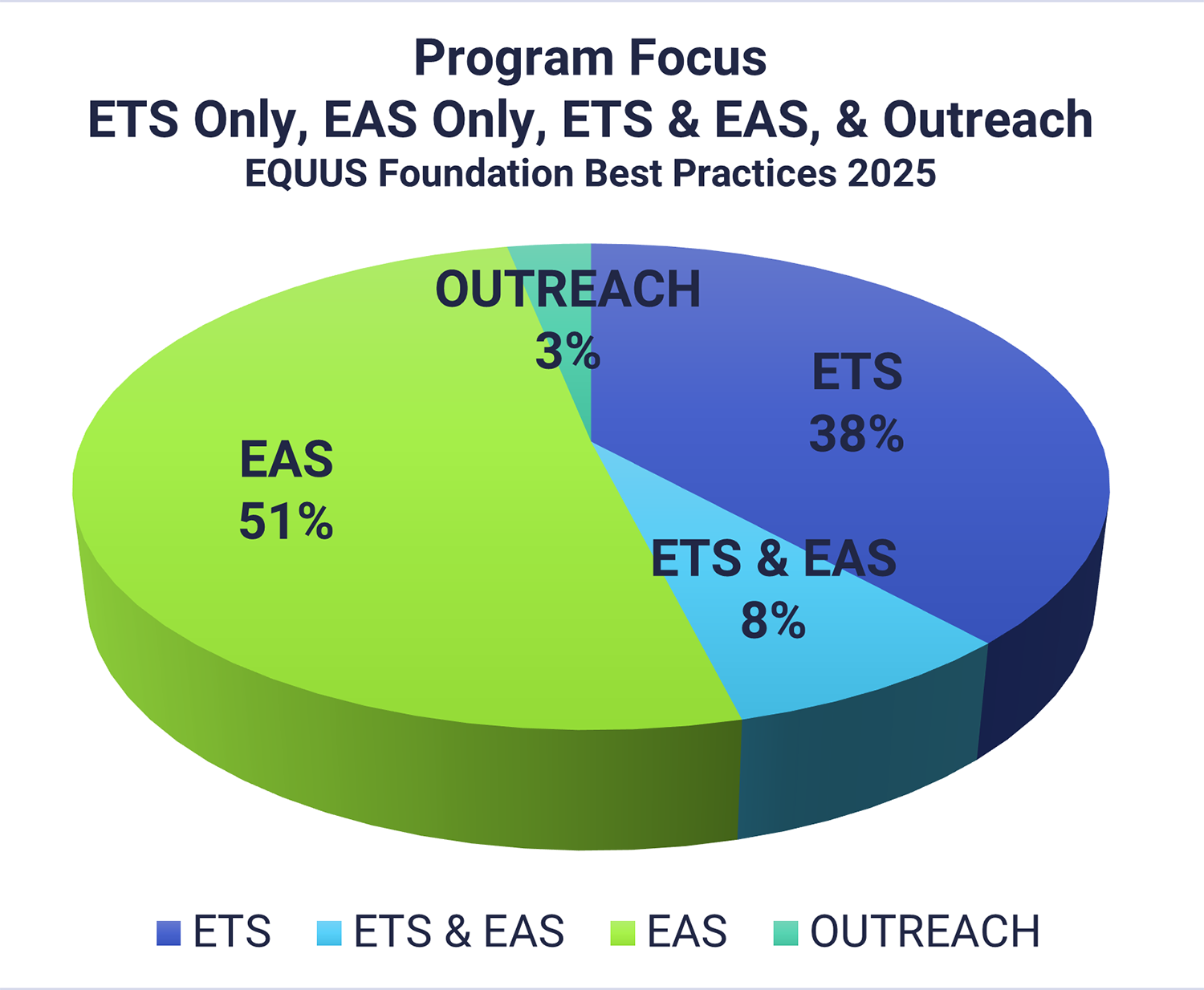
The Guardian organizations reflect a diverse equine welfare landscape. Fifty-one percent provide Equine Assisted Services (EAS) only, 38% provide Equine Transition Services (ETS) only, 8% provide both ETS and EAS, and 3% focus exclusively on outreach. Organizational longevity ranges from the minimum eligibility threshold of three years to more than five decades, underscoring both emerging and well-established models of equine care.
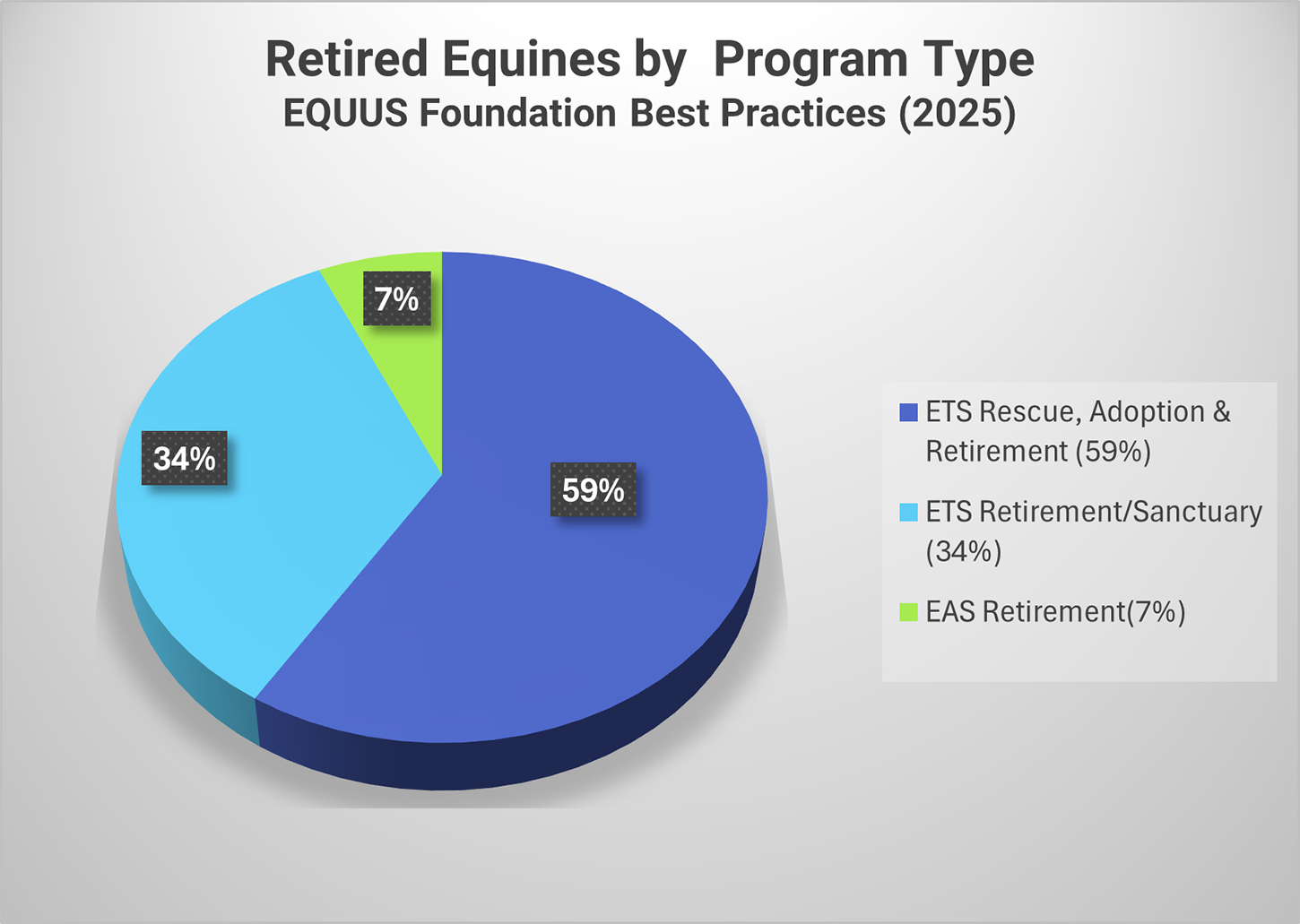
A defining distinction between ETS and EAS organizations is their approach to lifetime care. ETS charities - both adoption-focused and sanctuary/retirement-based typically assume lifetime responsibility for their equines, while EAS charities generally do not, reflecting differences in mission, intake sources, and equine utilization. Collectively, Guardian charities cared for 4,228 equines in 2024, of which 862 (approximately 20%) were designated as retired, meaning they were no longer adoptable (ETS) or no longer participating in services (EAS). Of these retired equines, 59% were cared for by adoption-focused charities, 35% by sanctuary and retirement charities, and 7% by EAS charities, highlighting the disproportionate role ETS organizations play in long-term equine care. Regardless of ETS or EAS mission, the EQUUS Foundation evaluates each organization’s mechanism for lifetime care and traceability, and requires robust mechanisms for organizations seeking Mentor status.
Financial and operational profiles further distinguish ETS and EAS models. ETS Guardians are more likely to operate with smaller budgets: 29% of ETS charities operate with annual expenses between $100,000 and $200,000, compared to 9% of EAS charities. By contrast, 34% of ETS and 36% of EAS charities operate with budgets between $300,000 and $750,000. Overall, 81% of Guardian organizations operate on a calendar fiscal year, and 83% file a full IRS Form 990, reflecting a high level of financial transparency. However, while 60% obtain either an audit or review by a CPA, 40% do not, representing a notable opportunity for strengthened financial oversight.
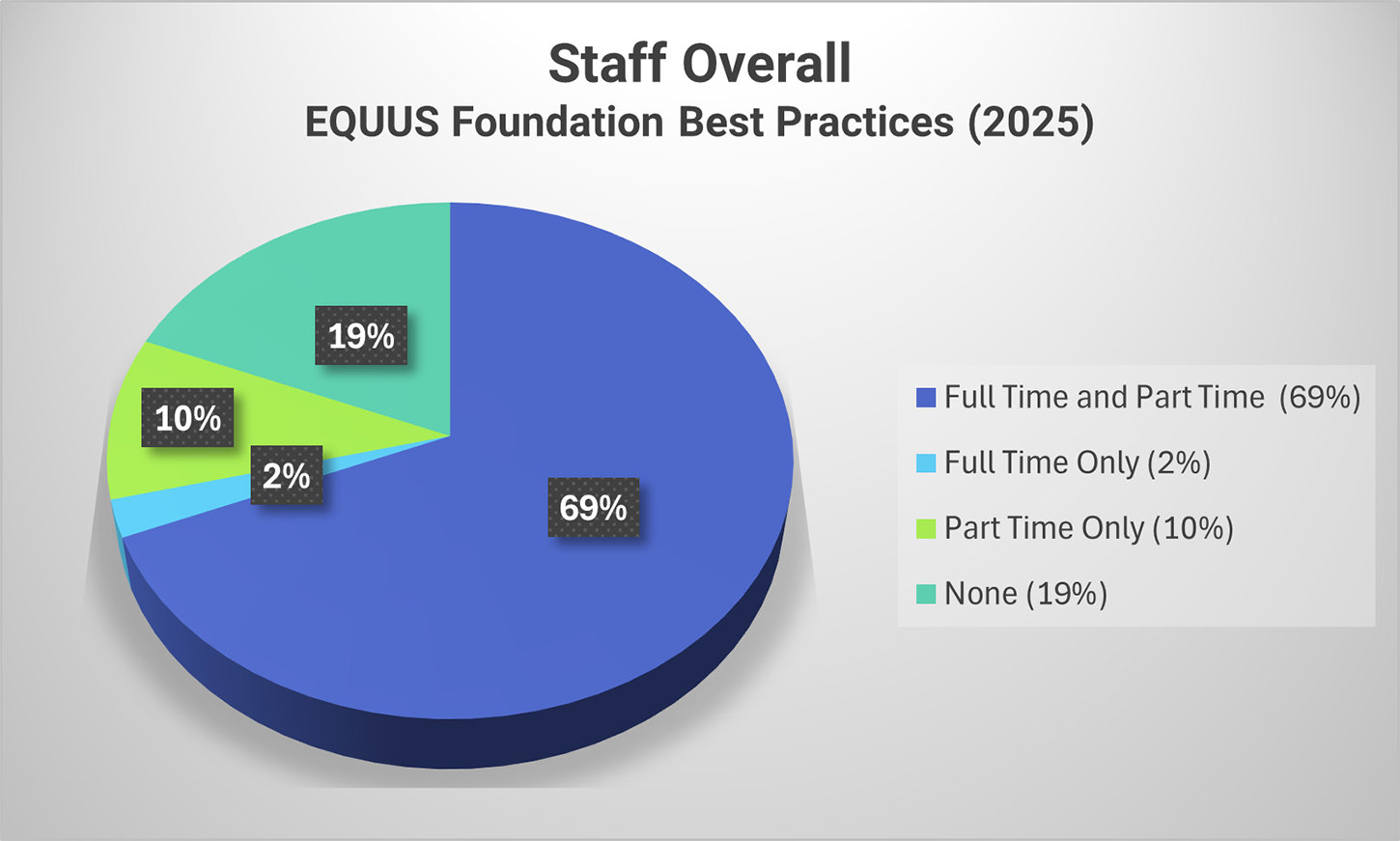
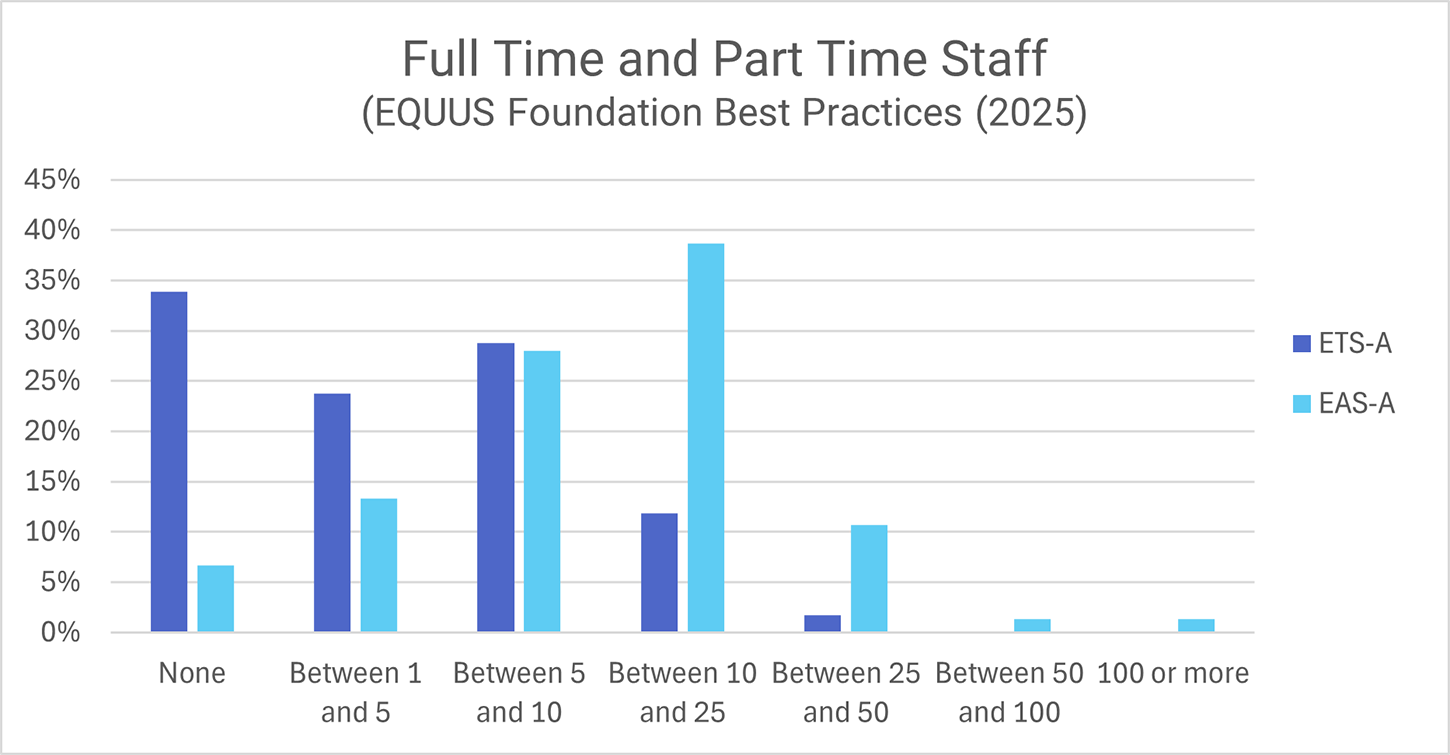
Staffing and volunteer reliance vary considerably. Overall, nineteen percent of Guardians operate entirely on a volunteer basis, but this figure masks significant differences: 34% of ETS charities operate without paid staff, compared to 7% of EAS charities. EAS organizations are more likely to maintain larger teams: 14% of ETS organizations operate with 10 or more staff members compared to 52% of EAS organizations.
There are 27 charities overall that rely 100% on volunteers for horse care - underscoring the essential role volunteers play in sustaining equine welfare operations. Of these 27 charities, six charities with paid staff rely 100% on volunteers for horse care with paid staff assigned to duties other than horse care.
Cost structures reveal common pressures across models. Hay and veterinary services are the two largest equine-related expenses, with hay alone representing approximately 25% of overall equine costs, followed by farrier costs. Feed, hay, and veterinary services account for a higher proportion of total budgets in ETS organizations than in EAS operations. Veterinary dental services are more commonly provided directly by veterinarians in ETS charities (41%) than in EAS charities (24%). While 81% of Guardians receive donated products or services, these contributions - apart from volunteer labor - do not significantly offset overall equine care costs.
Facility arrangements are relatively consistent across models: 39% of Guardians own their primary facility, 45% lease an entire facility, and 16% operate within a portion of a shared facility, with no meaningful differences between ETS and EAS organizations.
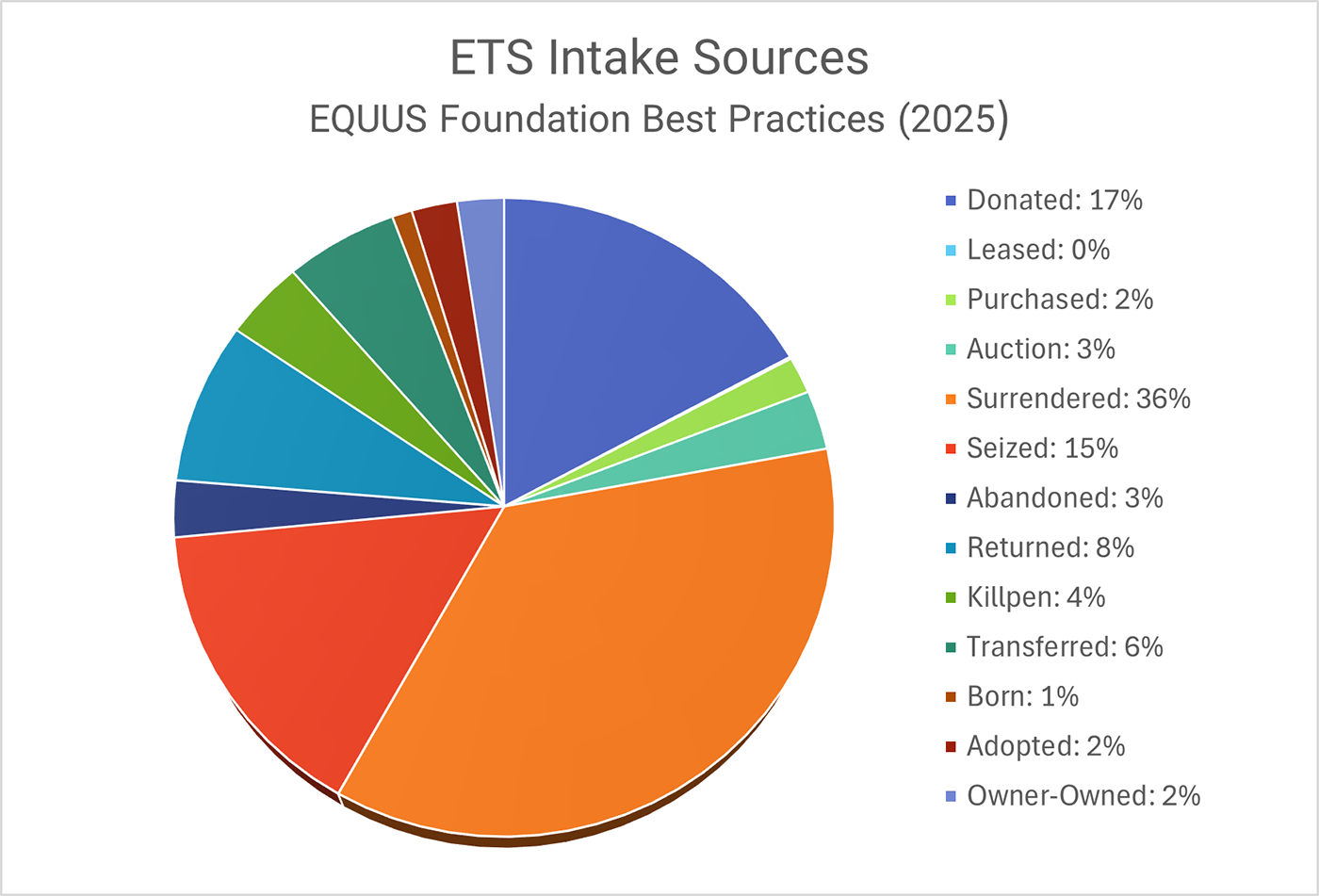
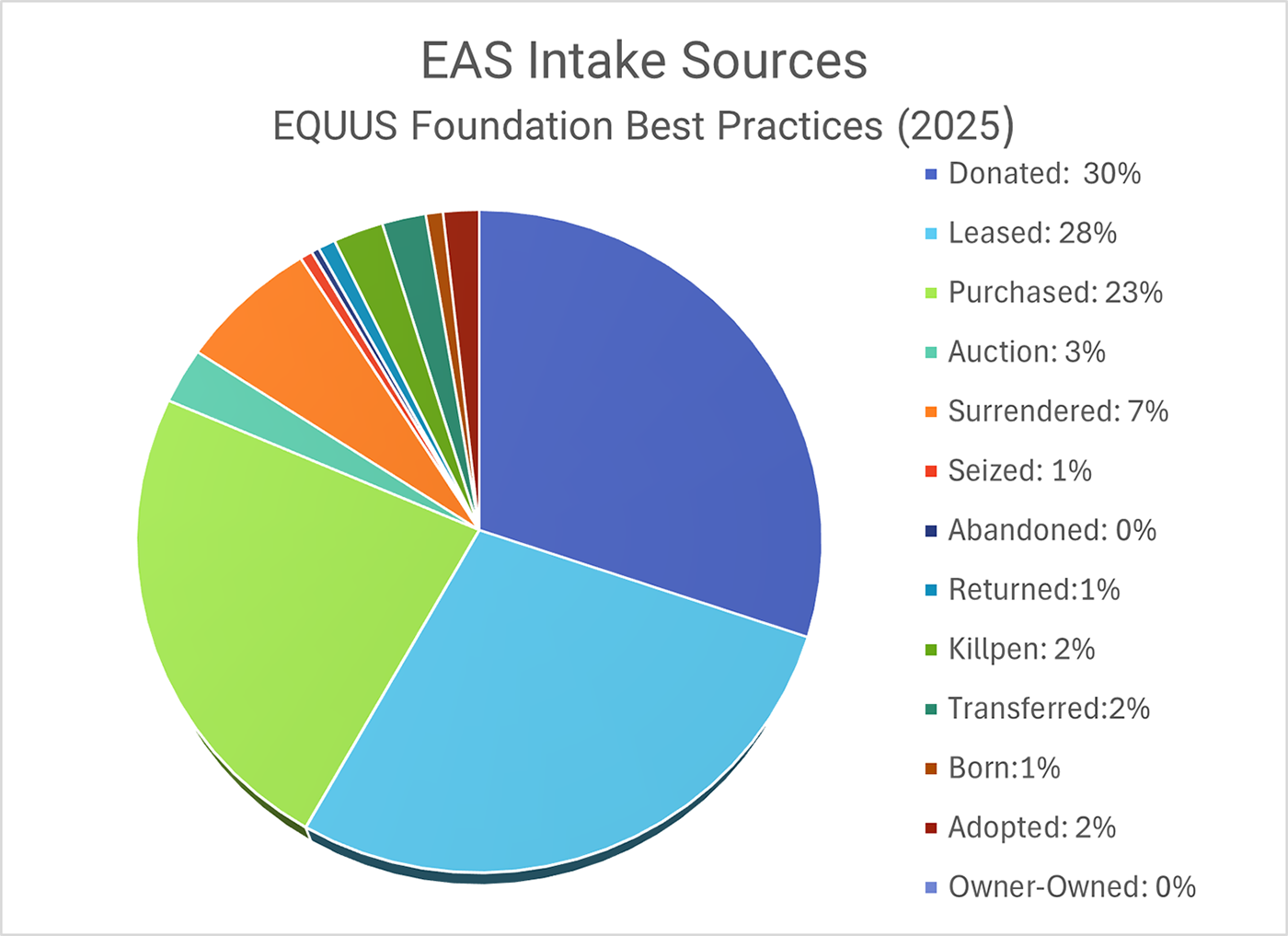
One of the most robust components of the Guardian designation process is the required equine census and cost reporting, which enables real-time assessment of intake, length of stay, adoption outcomes, capacity, and daily cost per equine. Intake patterns differ markedly between ETS and EAS organizations. ETS charities primarily receive equines through surrender (36%), donation (17%), and seizure (15%), while EAS charities rely largely on donated (30%), leased (28%), and purchased (23%) equines. Adoption returns were significantly higher for ETS organizations (8%) compared to less than 1% for EAS charities.
Finally, financial sustainability remains a core criterion of the Guardian designation. Organizations may be denied approval if financial data demonstrates liquidity of less than one month or insufficient cash reserves to absorb operating losses. Liquidity and cash reserve ratios are evaluated using the most recent financial statements, with historical trends reviewed when thresholds are not met.
Collectively, the findings affirm that ETS and EAS charities operate under distinctly different financial, operational, and equine care models, yet both play critical and complementary roles in the equine welfare ecosystem. The Best Practices identified through this analysis provide a data-informed framework to support stronger governance, operational resilience, and long-term equine welfare outcomes across the sector.
Acknowledgements and Thanks
Lynn Coakley, President, and the EQUUS Foundation Board of Directors, wishes to express its appreciation and thanks to the Guardian charities that are meeting the standards for equine welfare and business practices established by the EQUUS Foundation and to the individuals who provided essential guidance in the creation of this study:
Jo Anne Miller, Chair, EQUUS Foundation Equine Welfare Advisory Group and Executive Director, Brook Hill Farm
Dr. Karin Bump, EQUUS Foundation Chief Operating Officer
Timothy Williams, EQUUS Foundation Program Director
Debbie Anderson, ESMHL, CTRI, Founder and Executive Director, Strides to Success
Nina Ekholm Fry, Director of Equine Programs, Institute for Human-Animal Connection at University of Denver
Michael Kaufmann, Farm & Wildlife Director and the Director of The Sam and Myra Ross Institute, Green Chimneys
Kitty Stalsburg, Program Manager for Innovation Circles at PATH Intl.
Lynn Thomas, Co-Founder and President, Horses for Mental Health, and Co-Founder and CEO, Arenas for Change (ARCH)
Julia H. Wilson, DVM, DACVIM, Vice Chair, Brooke USA Foundation and Co-Founder, Equitarian Initiative
Close X
The EQUUS Foundation is the only national animal welfare public charity and accrediting body that is 100% dedicated to equine welfare with the dual purpose of protecting America's horses from peril and strengthening the horse-human bond.
The EQUUS Foundation provides financial support and programs to equine charities that:
• Find homes for at-risk and transitioning horses;
• Provide safe havens for aged or infirm horses and assist owners experiencing hardship;
• Expand opportunities for horses to engage, inspire, and empower people through therapeutic and outreach services in addition to sport and recreation.
The EQUUS Foundation uses the term, "horse or horses", to refer collectively to horses, donkeys, and mules, and is used interchangeably with the term "equine or equines" unless otherwise noted.
Our Vision
The EQUUS Foundation envisions a future where:
• All horses will naturally transition from one chapter to the next without risk of abuse, neglect and slaughter;
• All horses involved in any role and in any capacity - as athletes, companions, laborers, teachers and healers - are safe, healthy and treated with dignity as partners.
What We Do
• EMPOWER and INVEST in the very best equine charities that are finding homes for at-risk horses and horses in transition, providing a safe haven for aged horses, and increasing opportunities for all people to engage and partner with horses in new and innovative ways
• INSPIRE horse lovers to become horse protectors by stimulating advocacy and volunteerism
• EDUCATE the public on the value of horses in our lives to help elevate the image and desirability of horses by sharing stories of their amazing achievements and contributions
Learn more about what we do here
Close X
To ensure donor funds are used effectively, the EQUUS Foundation requires all supported organizations to meet rigorous standards of equine welfare and sound business practices. The data collected is used to evaluate each organization's programs, verify compliance, and strengthen our shared mission of ensuring the well-being of all equines. By improving welfare, transparency, and opportunity across the sector, the EQUUS Foundation helps ensure a sustainable, respected, and compassionate future for horses, and, in turn, the people who benefit from their interaction with them.
Data is collected annually from equine charities seeking to attain or renew the EQUUS Foundation Guardian designation and the Mentor Accreditation. Once approved, the majority of the data is displayed publicly in an organization profile on the EQUUS Foundation's Equine Welfare Network for public scrutiny.
Guardian Designation: The EQUUS Foundation Guardian designation is a national recognition awarded to equine organizations, including those providing Equine Transition Services (ETS), Equine-Assisted Services (EAS), and Community Outreach (CO), that meet the EQUUS Foundation standards for equine welfare and business practices and demonstrate a commitment to public transparency by their willingness to make comprehensive data about their programs, practices and operations available for public scrutiny.
The Guardian designation:
• Confirms a charity's commitment to transparency in its practices in equine welfare and management,
• Builds public trust through transparency and accountability,
• Strengthens the credibility of the equine industry
Achieving this designation involves a rigorous process in which organizations submit detailed information about their programs, finances, and equine welfare practices. This process ensures accountability and transparency, giving donors, adopters, volunteers, and the public confidence that the organization is responsibly managing resources and providing exceptional care for its horses.
Equine charities attain the EQUUS Foundation Guardian Designation annually by meeting the standards for equine welfare and business practices set forth in the EQUUS Foundation (EQUUS Foundation Eligibility Requirements) and making their equine welfare and business practices available for public scrutiny.
Mentor Accreditation: The Mentor Accreditation is an advanced recognition awarded by the EQUUS Foundation to existing Guardian organizations that not only maintain the highest standards of equine care, organizational management, integrity, and transparency, but they also share their expertise, best practices, and guidance with newer or developing organizations in the field, helping to elevate welfare and operational standards across the broader equine community.
Data Collection Process: Each completed submission is reviewed, and key fields - such as demographic details, program selection, and other relevant criteria - are recorded in a structured format. The data is then checked for accuracy, completeness, and consistency, with any missing or unclear information addressed as needed. Once organized, the data is analyzed to identify trends, assess eligibility, and inform program planning, while maintaining strict confidentiality and secure storage of all personal information.
For the 2025 Guardian cycle, 161 organizations submitted data starting in December 2024 culminating in July 2025. Of the 161, 128 attained the Guardian designation in 2025; 33 applications were deferred to the next cycle because 1) they did not complete the information required and/or 2) they did not meet the eligibility requirements at the time of submission.
The purpose of the study is to compare the policies, operations and practices, hereinafter referred to as "Best Practices", of the 128 equine charities that attained the EQUUS Foundation Guardian designation in 2025.
Close X
All 128 Guardians conduct Equine Transition Services (ETS), Equine Assisted Services (EAS) and/or Community Outreach defined as follows:
Equine Assisted Services (EAS): Services in which professionals incorporate horses and other equines to benefit people. Three areas of EAS have been identified: Therapy, Learning and Horsemanship. These services are further defined in the EQUUS Foundation Guidelines for Conducting Equine-Assisted Services.
Equine Transition Services (ETS): Services involved with equines in transition, including the rescue of equines at peril, rehabilitation, training, re-homing, and/or the provision of sanctuary and/or retirement of equines.
• Equines in Transition: Any equine that is currently in transition from one home, vocation, opportunity or owner to the next. Throughout its lifetime, most horses will have multiple homes and owners. Often, these horses find themselves in transition due to no fault of their own, rather when their owners cannot, or no longer wish to, care for their horses as the result of a change in the owner's circumstances.
• Equines at Risk/Peril: An equine that has an increased possibility of experiencing a situation of neglect, abuse, general poor welfare, and/or an inhumane death.
Community Outreach/Outreach: Public education programs and activities that incorporate equine interactions and/or the equine environment, mounted or unmounted, aimed at educating the public about the horse-human bond and issues impacting the welfare of horses, and allowing the public to experience how horses enhance lives of people; such programs and activities include, but are not limited to, off site visits with horses at hospitals, nursing homes, and schools, on site tours, seminars and clinics, camps, volunteer/community service programs, and mounted and unmounted lessons and/or activities - OTHER THAN Equine Assisted Services (EAS) which requires a credentialed service provider.
The purpose of the study is to compare the policies, operations and practices, hereinafter referred to as "Best Practices", of the 128 equine charities that attained the EQUUS Foundation Guardian designation in 2025. Of these charities, 51% conduct EAS only, 38% conduct ETS only, 8% conduct both ETS and EAS and 3% conduct Outreach only.
Below are examples of organizations that are focused on ETS Only, EAS Only, both ETS and EAS and Outreach Only:
Equine Transition Services (ETS) Only: Colorado Horse Rescue and Days End Farm
Equine Assisted Services (EAS) Only: Sprout Therapeutic Riding and Education Center and Thorncroft Equestrian Center
Both ETS and EAS: Brook Hill Farm and Lucky Orphans Horse Rescue
Outreach Only: Mini Therapy Horses and Southlands Foundation
Since only 3% of the charities conduct Outreach only, the study does not breakout this group.
Also, since 8% of the charities conduct both ETS and EAS, the data from this combined group is reported in both the ETS and EAS groups.
Equine Transition Services (ETS)
The data in the ETS group includes the charities that
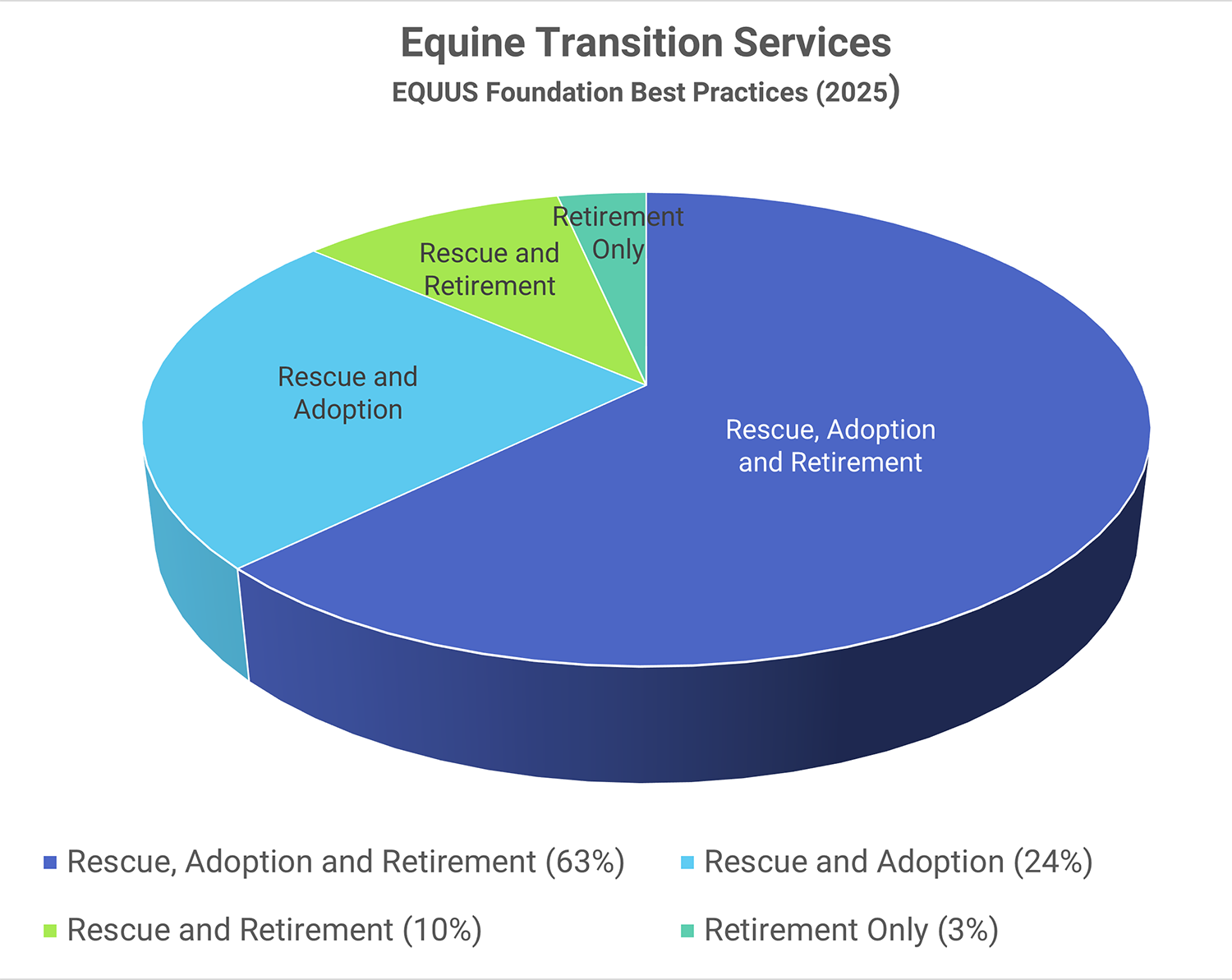
only conduct ETS and the charities that conduct both ETS and EAS. Of these charities, the majority provide rescue, adoption and retirement services:
Equine Assisted Services (EAS)
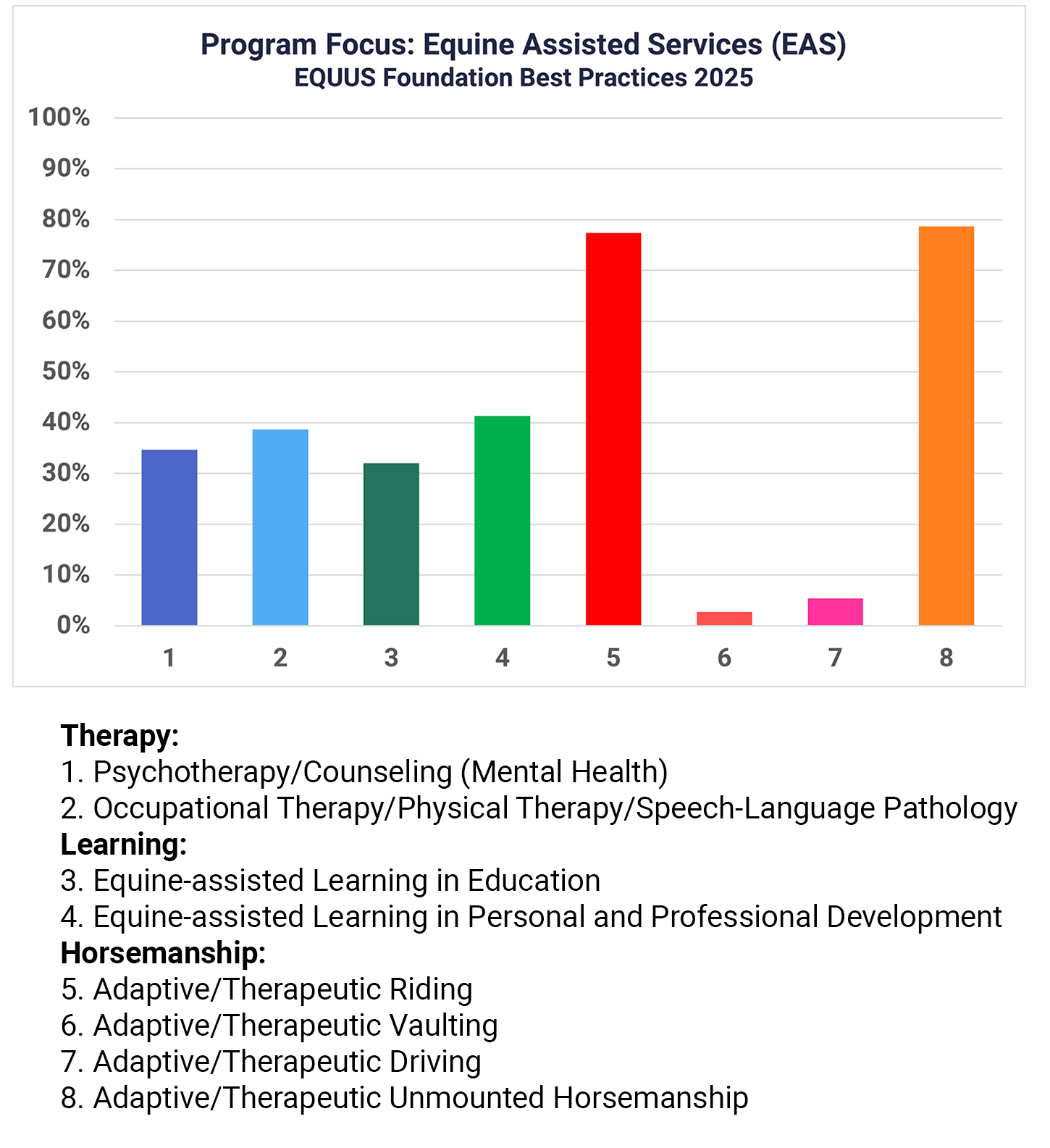
The data in the EAS group includes the charities that only conduct EAS and the charities that conduct both ETS and EAS. Of these charities, the majority provide more than one service. These services are further defined in the EQUUS Foundation Guidelines for Conducting Equine-Assisted Services.
Outreach
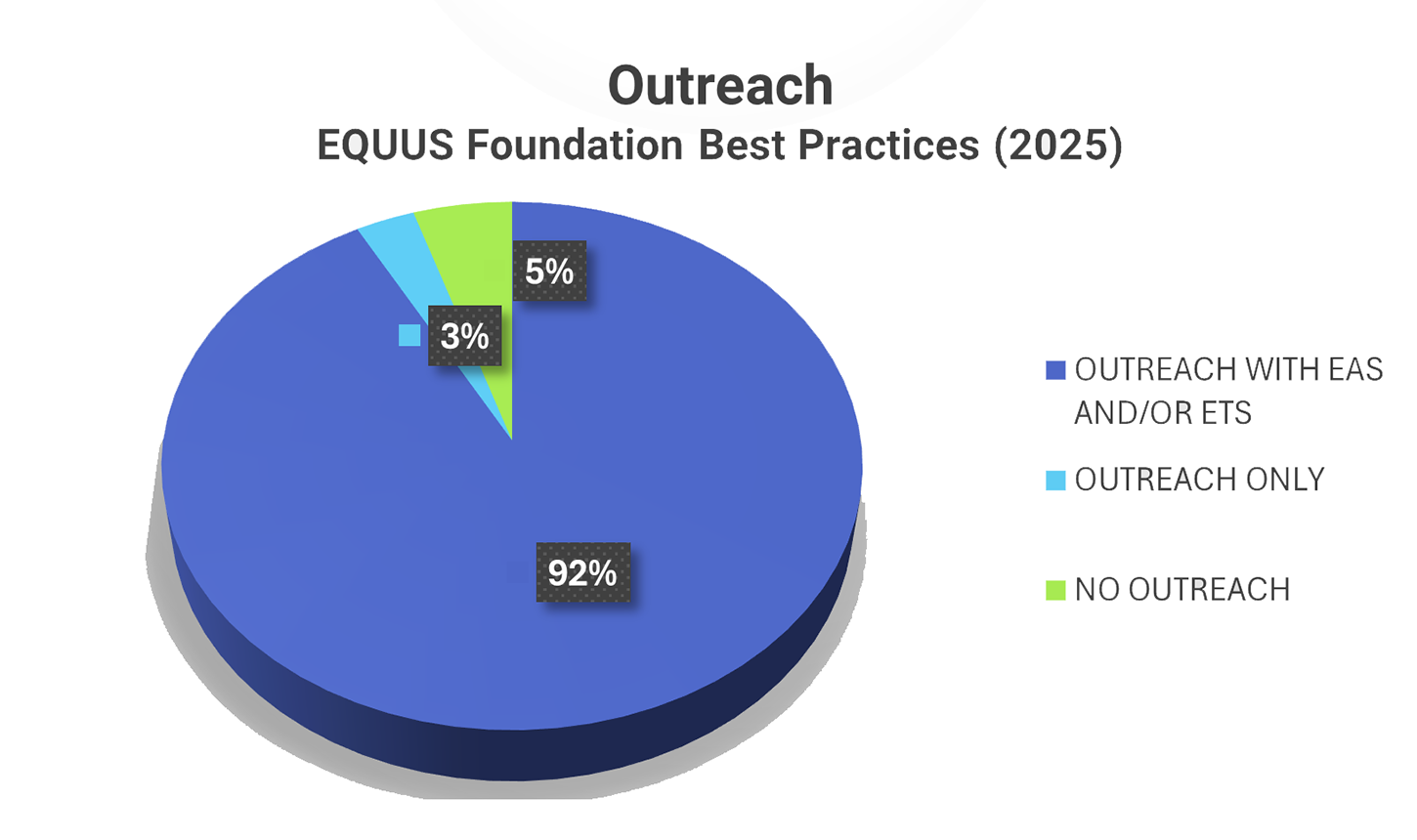
Of the 128 charities, even though only 3% provide Outreach programs only, 92% of the ETS and EAS charities also conduct Outreach programs, making the total 95% conducting Outreach; 5% of the charities do not conduct Outreach programs:
Close X
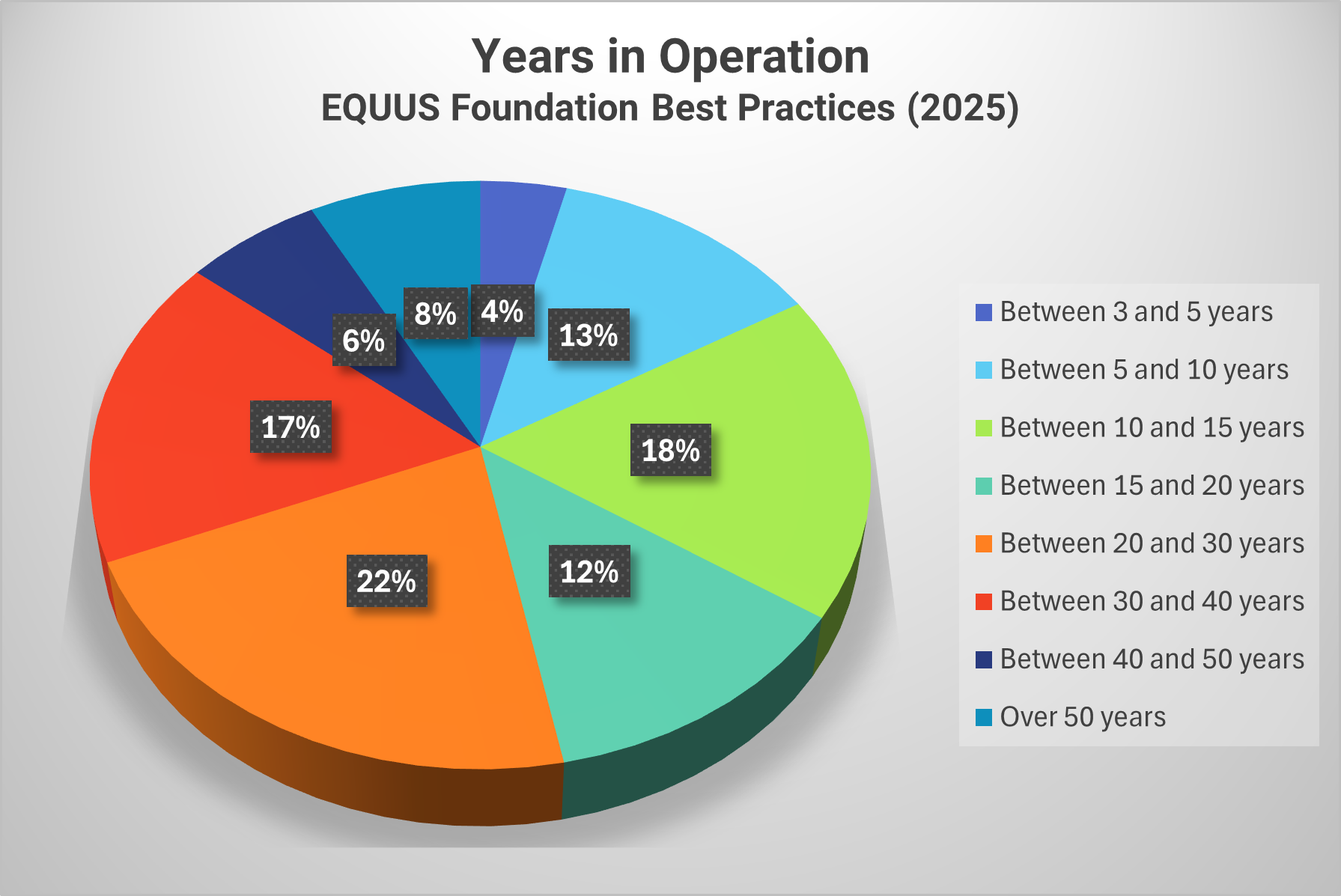
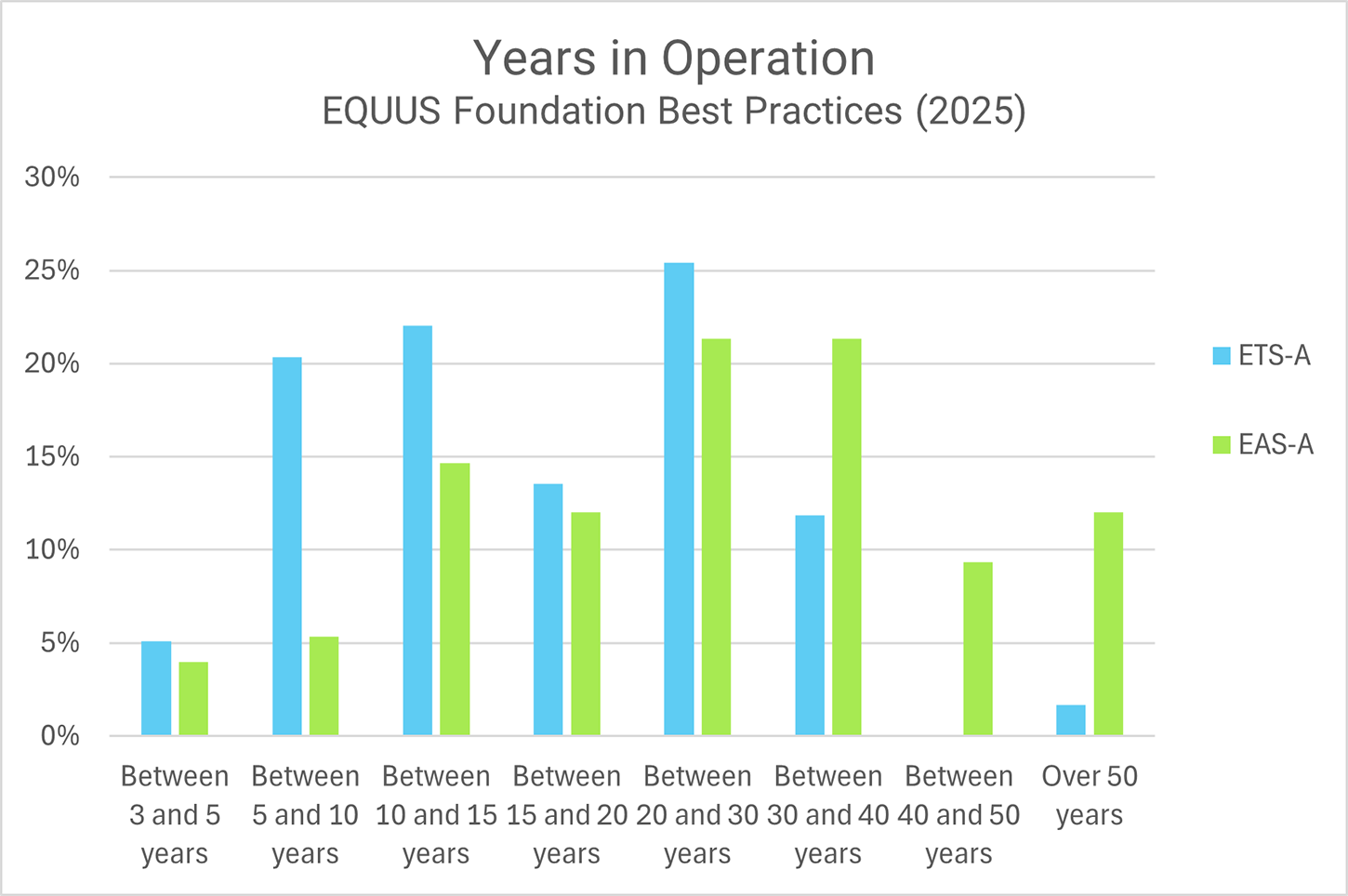
To attain the EQUUS Foundation Guardian designation, the organization must have been operational as a tax-exempt 501c3 public charity for at least 3 years.
Of the 128 Guardians, 40% own their main facility compared to 45% that lease an entire facility to serve as their main faciliy and 15% use a portion of an existing facility to serve as their main facility. There was no appreciable difference between ETS and EAS charities.
There was a difference between ETS and EAS in the number of facilities utilized by the Guardians to conduct their operations. Whereas 36% of the ETS charities utilized satellite, overflow, temporary, and/or foster facilities in addition to their main facility; only 13% of EAS charities conducted operations at multiple locations.
Of the 128 Guardians, the main facility of ETS charities had more acreage than EAS charities; for example, only 6% of ETS charities operated on 5 acres or less compared to 14% of EAS charities but acreage varied widely depending on the geographic region and the number of equines.
Roughly 15% of the charities conduct programs involving animals other than equines or, in the case of EAS charities, provide other therapeutic services.
Geographic Breakdown
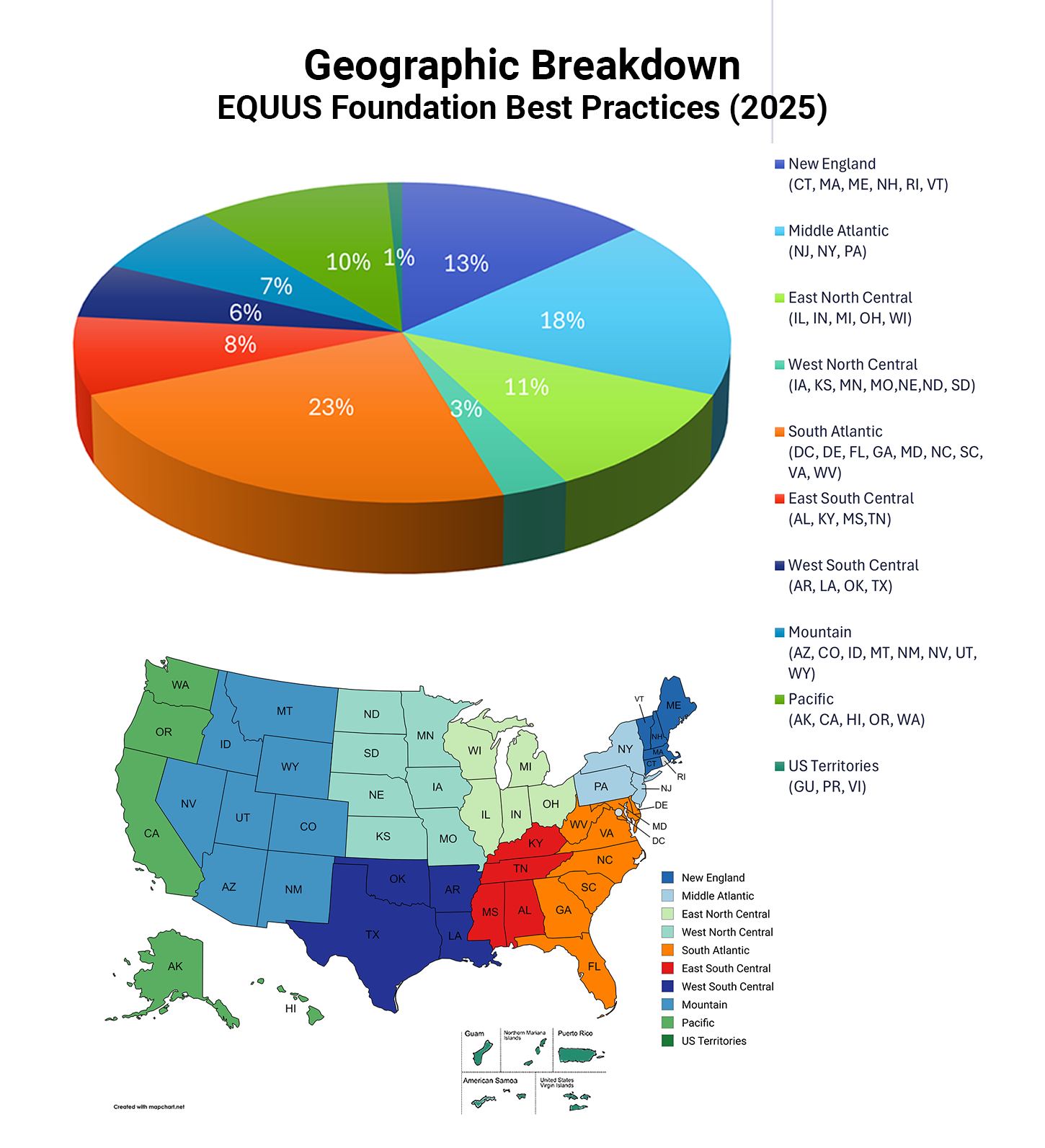
Guardians are located in all states except Alabama, Alaska, Arkansas, Delaware, District of Columbia, Hawaii, Idaho, Iowa, Louisiana, Mississippi, Montana, Nebraska, Nevada, North Dakota, Rhode Island, South Dakota, Utah, and West Virginia. There was no appreciable difference in the locations of ETS and EAS charities.
Close X
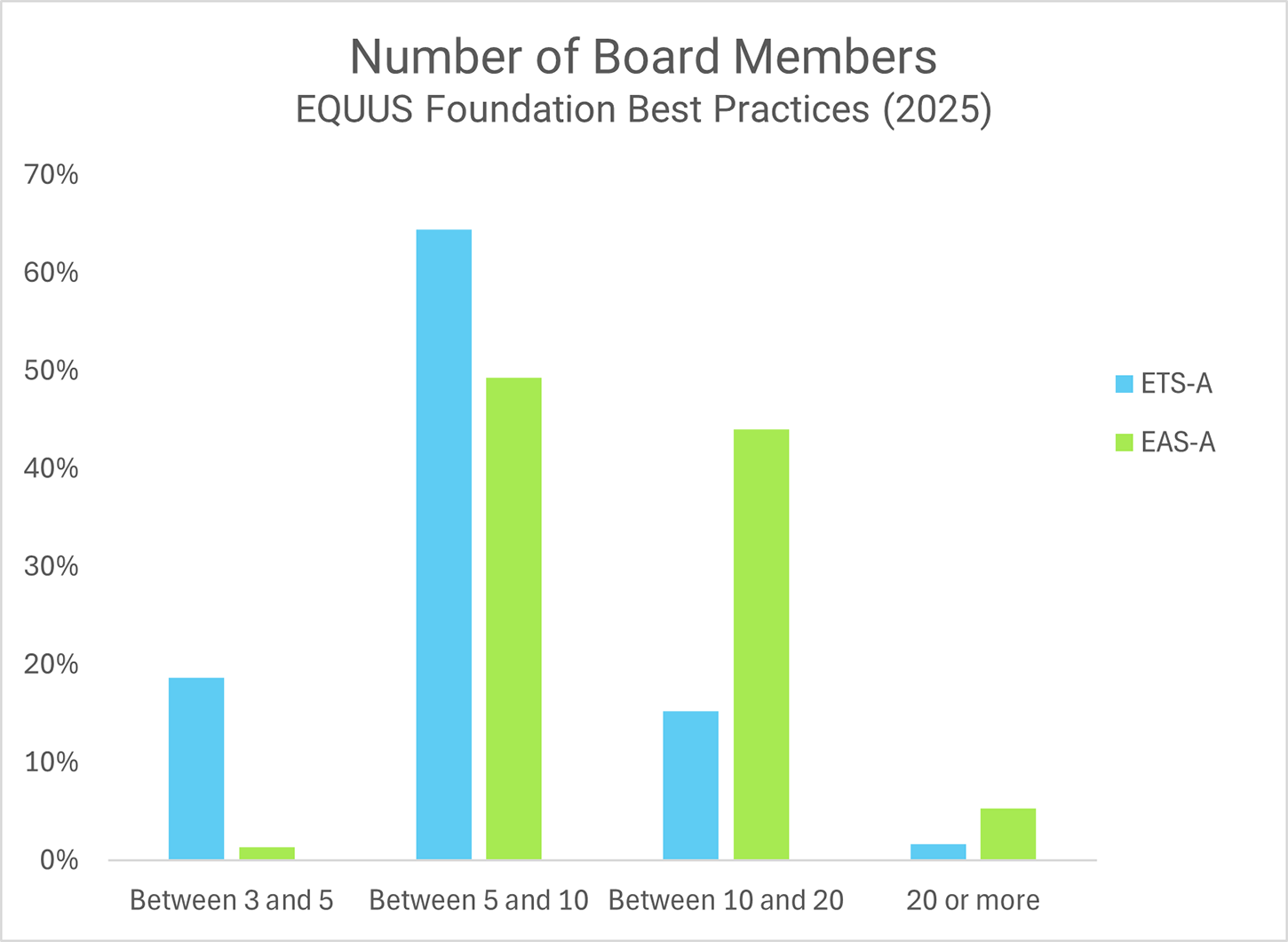
The EQUUS Foundation requires that the organization's programs and activities are directed by an active and responsible governing body; that all organizations have a governing board of at least three (3) members and that the governing body of the organization meets at least annually and preferably quarterly.
Close X
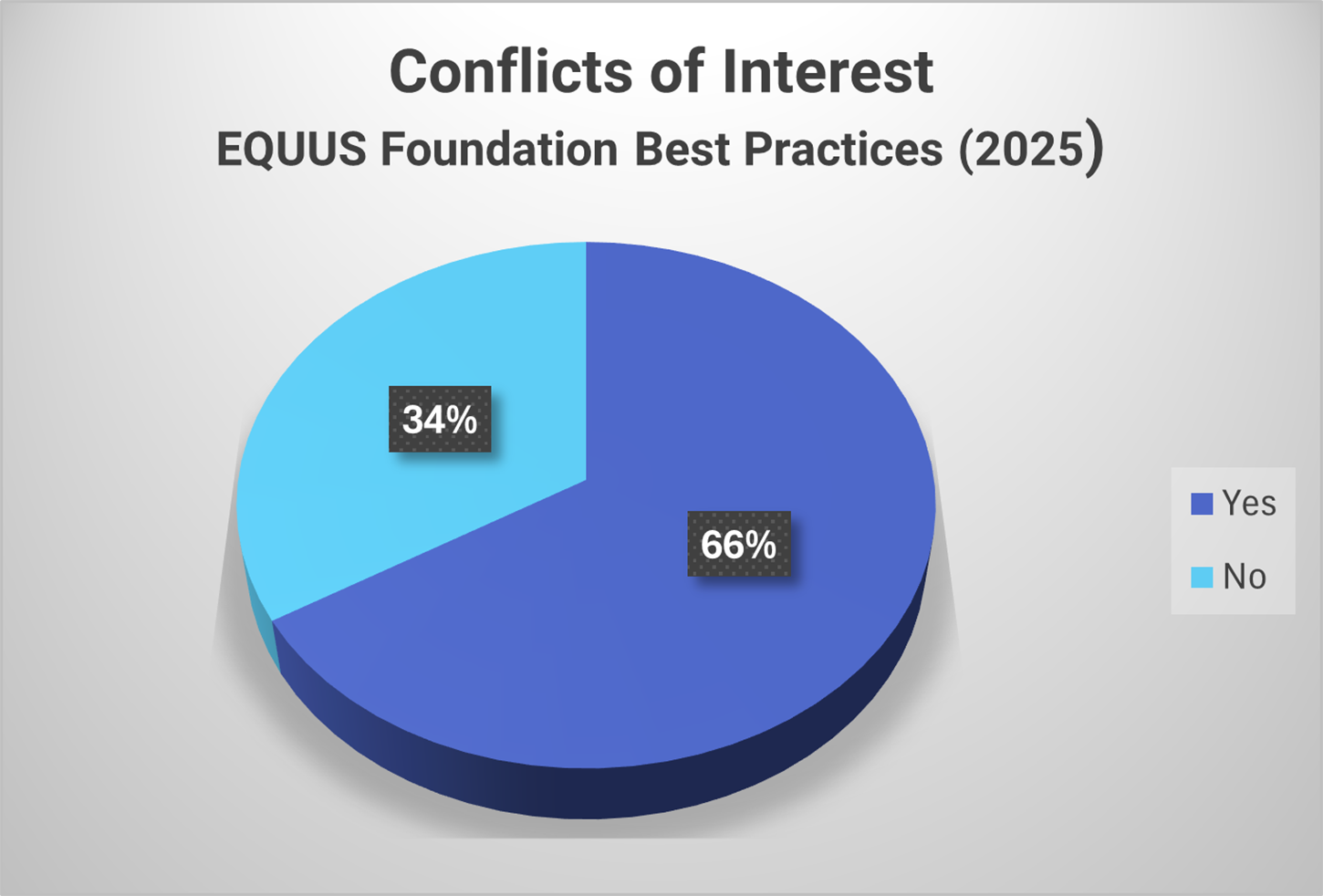
The EQUUS Foundation requires that the organization has a written conflict of interest policy that ensures that any compensated board member is a NON-VOTING (Independent) board member or that any compensated board member or any board member related to a compensated staff member, independent contractor, or any related board members, or any individual or organization that might benefit from a board decision, abstains from voting on issues impacting such compensation and requires officers, directors or trustees, and key employees to disclose at least annually in writing interests that could give rise to conflicts.
The EQUUS Foundation requires that Guardian charities make any conflicts of interest available for public scrunity, including whether or not:
• any members of the Board, Staff or Program Participants are compensated,
• any members of the Board, Staff or Program Participants are related to each other through family or business relationships,
• any Board members are providing services to the organization or compensated by the organization,
• any Board members or staff members are associated with and/or compensated by another organization with a relationship or business affiliation to your organization.
For Mentor charities, the organization's governing body must consist of a majority of members who have no material conflict of interest and a majority of which serve without compensation including the chairperson and the treasurer.
While the majority of both ETS and EAS charities have conflicts of interest, 71% of ETS charities have conflicts versus 62% of EAS charities.
Close X
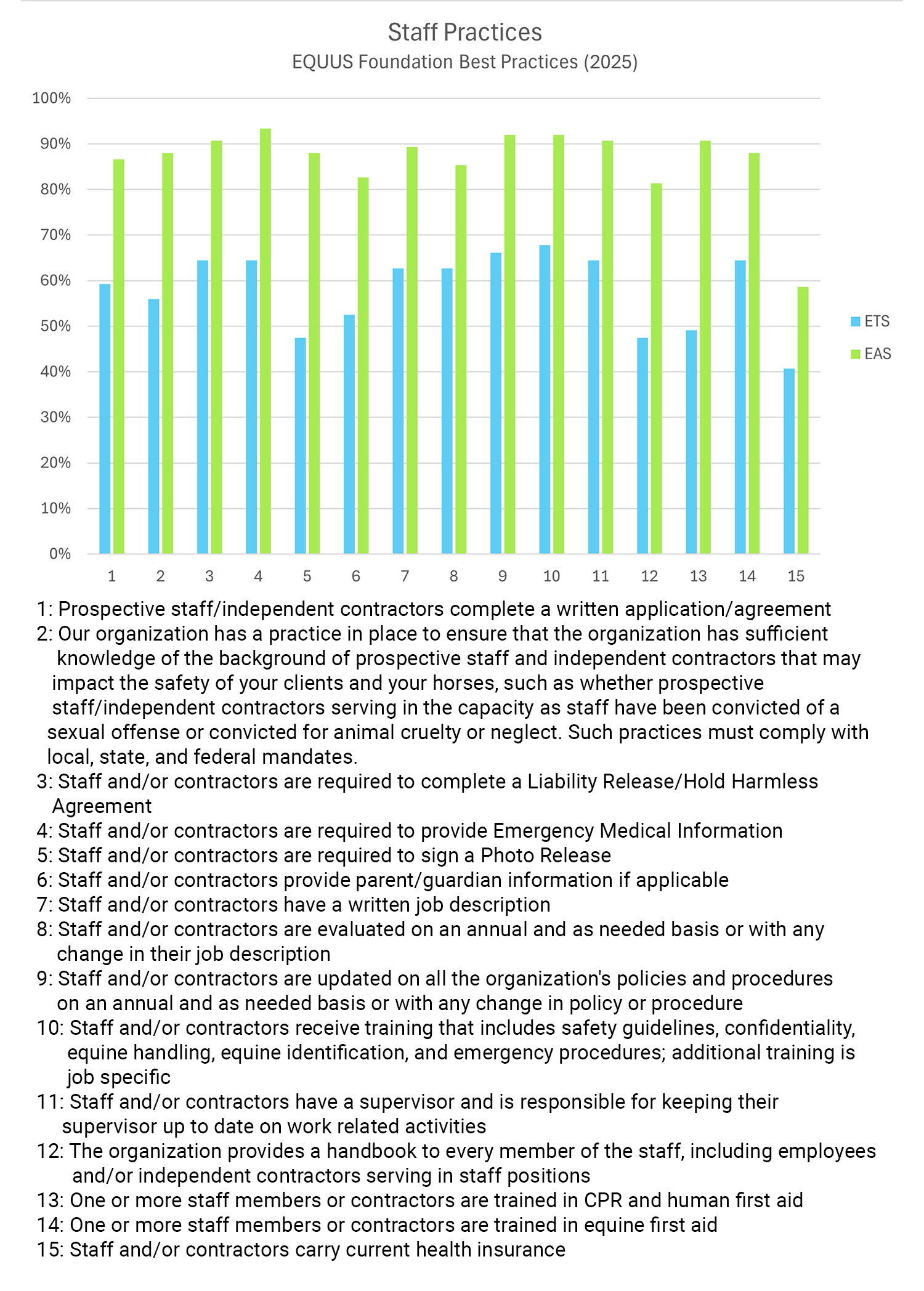
Of the 128 Guardians, overall, 19% operate on a volunteer-basis but comparing ETS and EAS, 50% of the ETS charities operate without staff compared to 12% of the ETS charities. The number of full-time and part-time staff varies with 80% of the ETS charities operating with under 10 staff members compared to 44% of EAS charities.
Staff practices vary especially among ETS and EAS charities.
To attain the Mentor Accreditation, the EQUUS Foundation requires that the organization has a practice in place whereby prospective and existing staff and/or independent contractors serving in staff functions complete a written application or agreement and that staff and/or contractors receive training that includes safety guidelines, confidentiality, equine handling, equine identification, and emergency procedures.
Close X
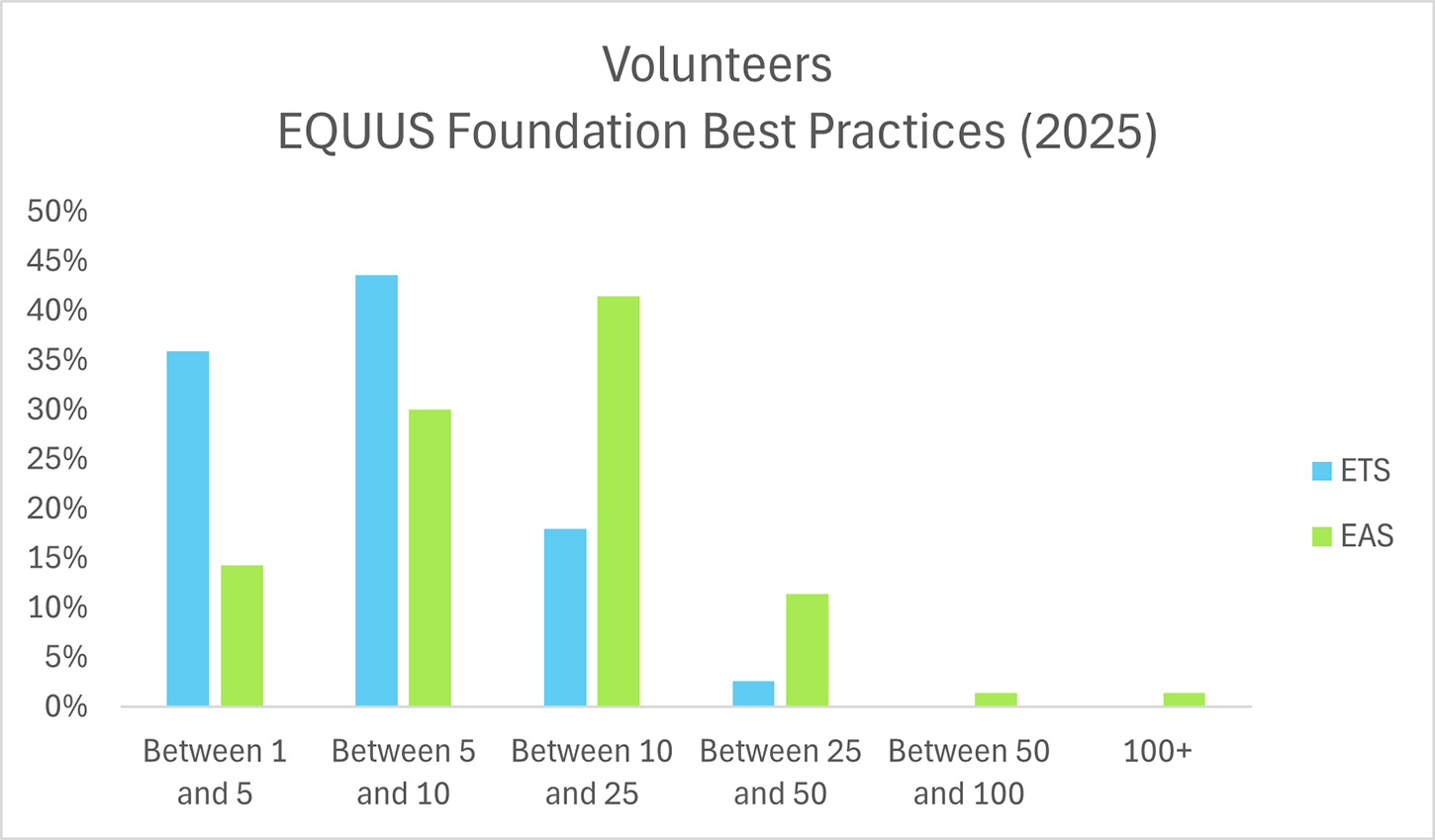
All the Guardians rely on volunteers with the number ranging from five to 1,200 and totalling 14,993. While the average computes to 117, the actual number of volunteers varies at each organization.
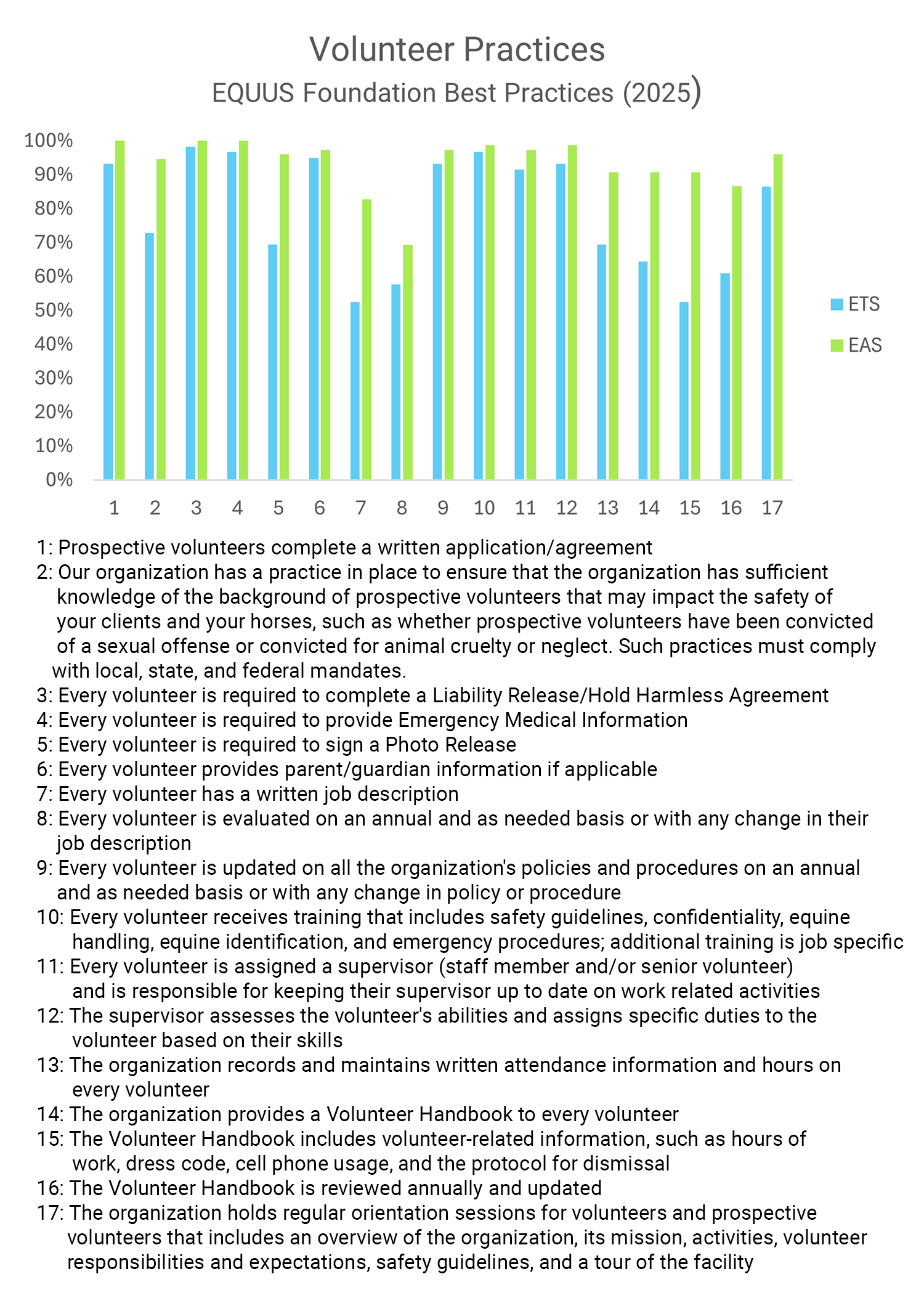
As with staff, volunteer practices vary especially among ETS and EAS charities.
Close X
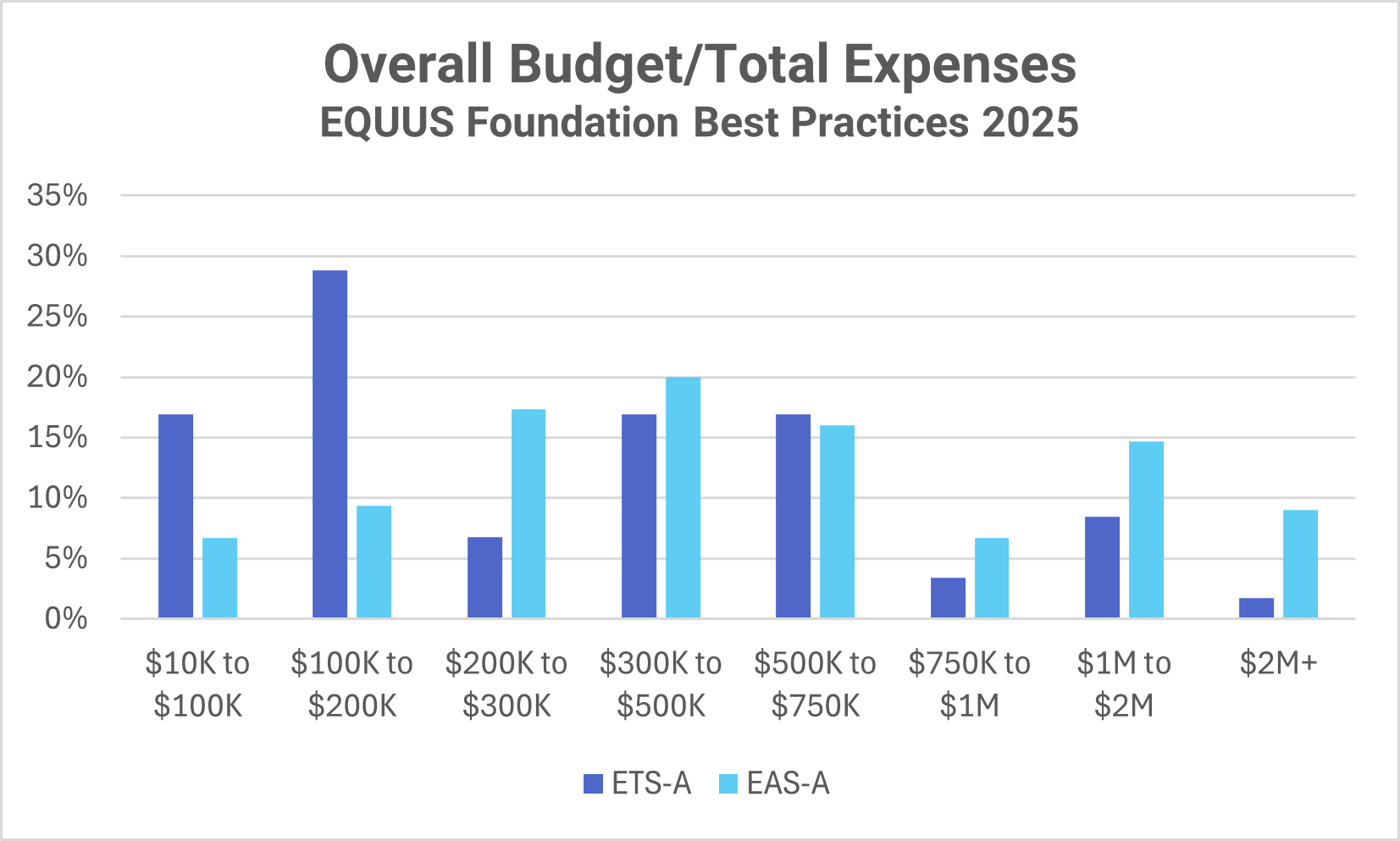
Total expenses represent total expenses reported on the organization's most recently filed 990 at the time the Guardian designation was awarded. The largest percentage (29%) of ETS Guardians operate with a budget between $100K and $200K vs. 9% of EAS charities. 34% of ETS charities operate with budgets ranging from $300K to $750K vs. 36% of EAS charities.
Overall, 81% operate on a calendar year basis. While 83% file the complete IRS 990, 15% filing the 990-EZ and 2% filing the 990-N. While 32% have an audit of their financial statements conducted by a CPA and 28% have a review conducted, 40% of the Guardians do not have either an audit or review conducted by a CPA of their financial statements.
Close X
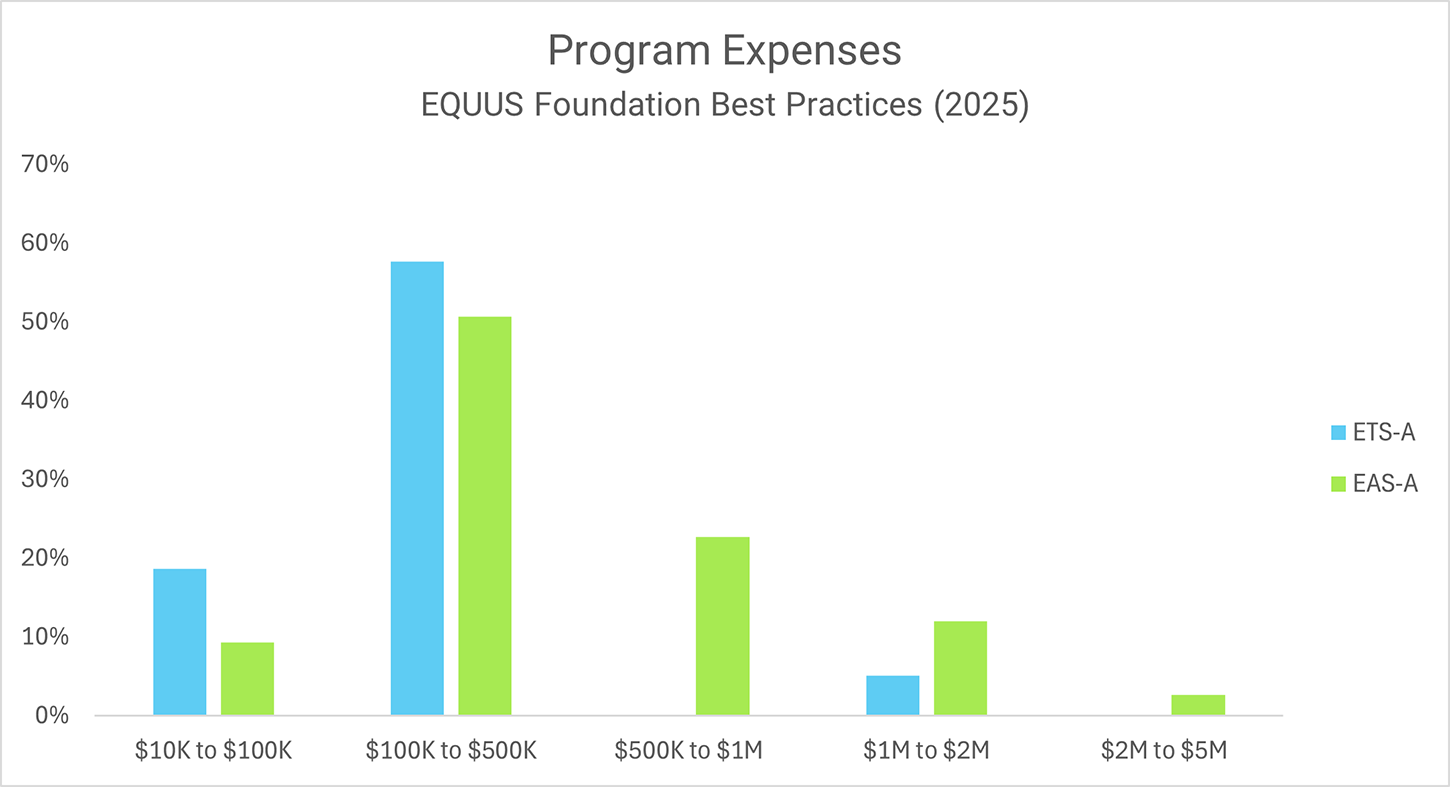
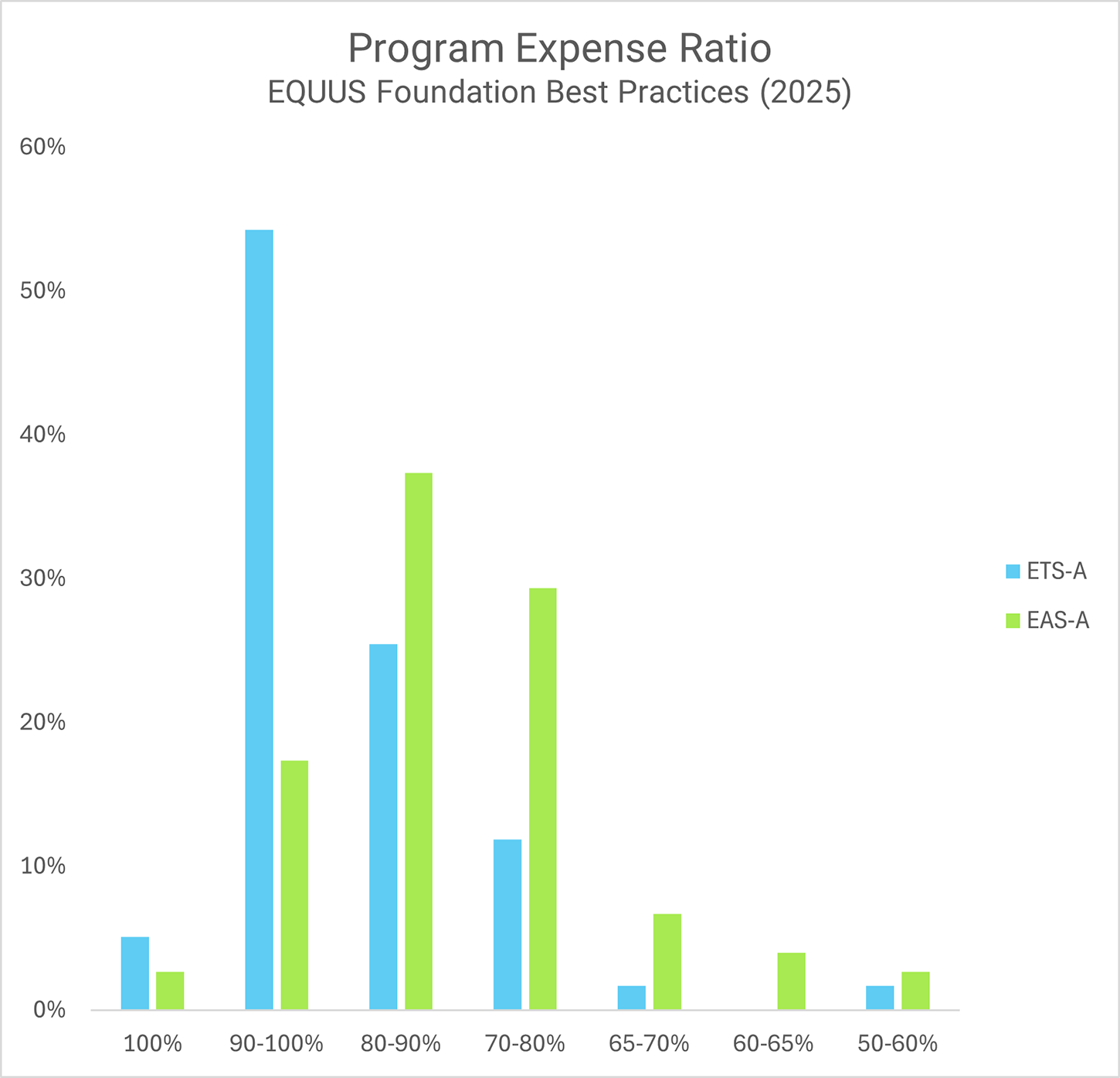
Program expenses represent program expenses reported on the organization's most recently filed 990 at the time the Guardian designation was awarded and generally align with total expenses.
One charity involved with Outreach only has program expenses of less than $10K and two EAS charities have program expenses greater than $10 million; however, the majority of their expenses are associated with non-equine related programs.
Close X
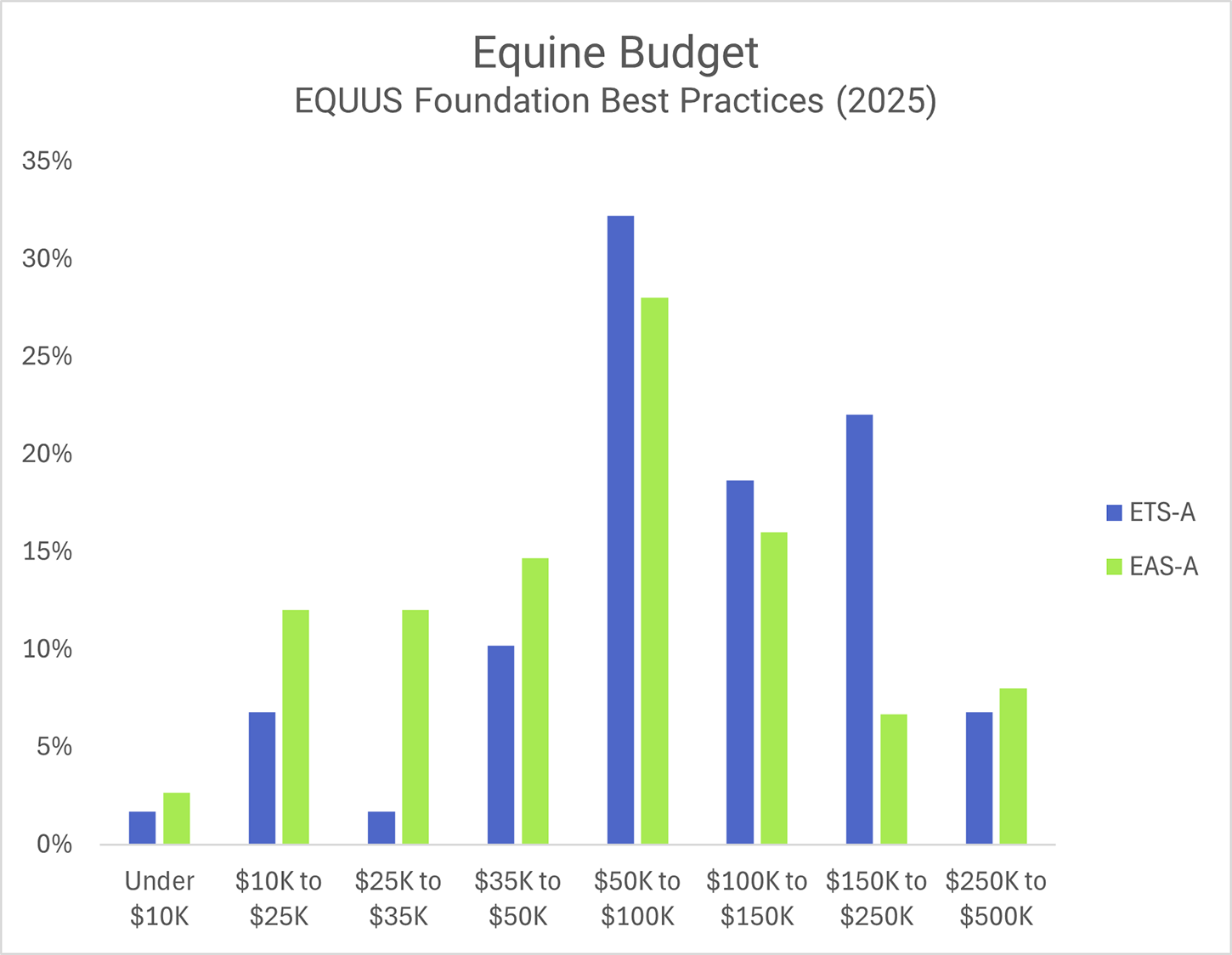
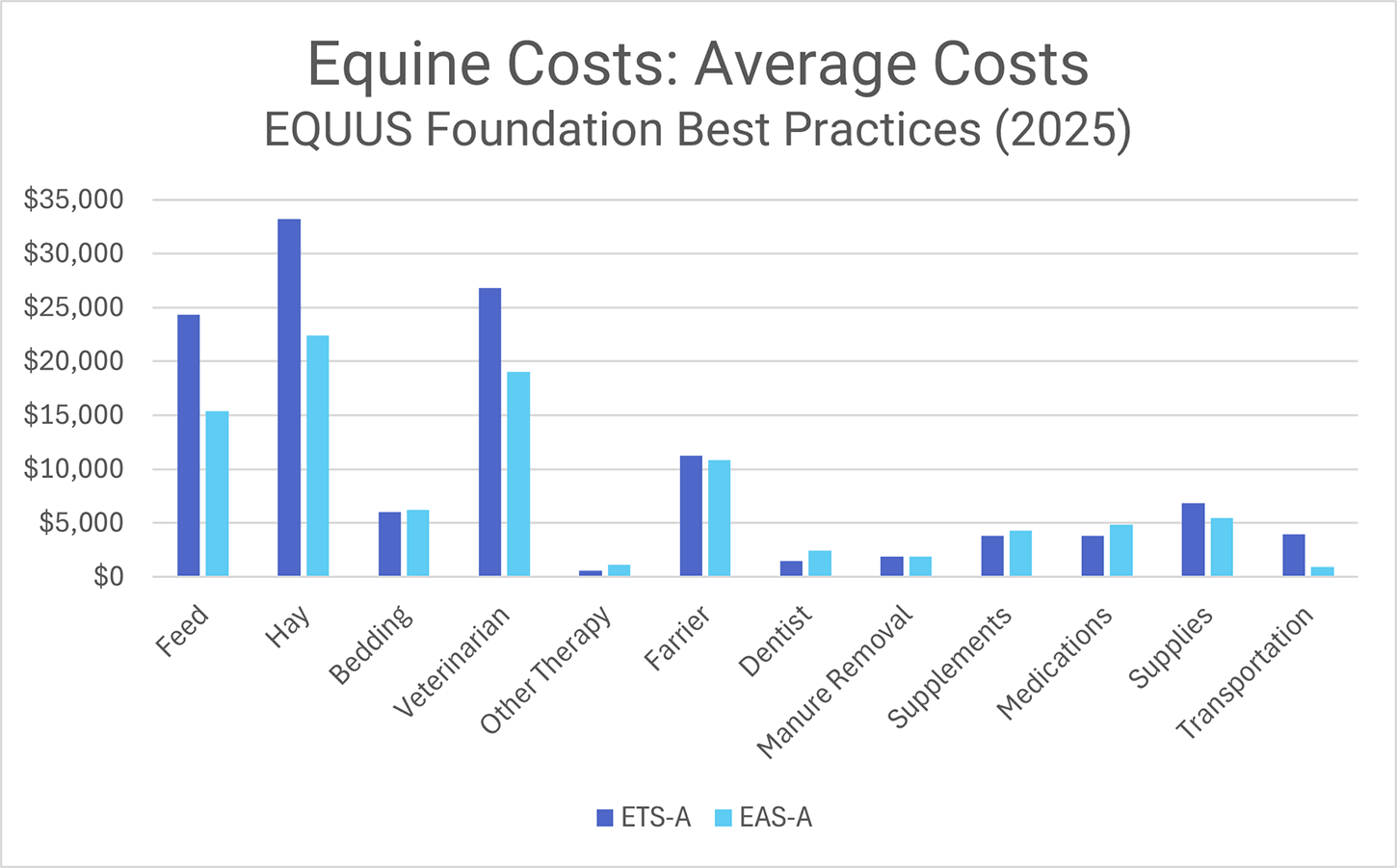
For the purposes of this study, the Equine Care Expenses includes the cost of Feed (Grain), Hay, Supplements, Medications, Bedding, Veterinarian, Farrier, Dentist, Other Therapies, Manure Removal, Horse Transportation and Horse/Barn Supplies. Guardian charities also provide the cost of maintenance and other equine-related expenses not included above, as well as the cost of staff specifically dedicated to horse care and training.
Overall Costs
The cost of hay followed by the cost of veterinarian services are the two highest costs with the cost of hay representing 25% of the overall equine budget. Regarding veterinarian and dental services, 40% of ETS charities have their veterinarian provide dental services vs. 24% of EAS charities.
Daily Costs
Daily Direct Equine Costs are the cost of Feed (Grain), Hay, Supplements, Medications, Bedding, Veterinarian, Farrier, Dentist, Other Therapies, Manure Removal, Horse Transportation and Horse/Barn Supplies.
Daily Total Equine Costs include the direct costs plus the cost of maintenance, other equine-related expenses not included above and the cost of staff specifically dedicated to horse care and training.
While 81% of Guardians receive donated products and services, the impact on the overall equine costs is not significant other than donations of time by volunteers.
There are 27 charities overall that rely 100% on volunteers for horse care; 21 have no paid staff; 6 charities with paid staff rely 100% on volunteers, but they have paid staff assigned to duties other than horse care.
Close X
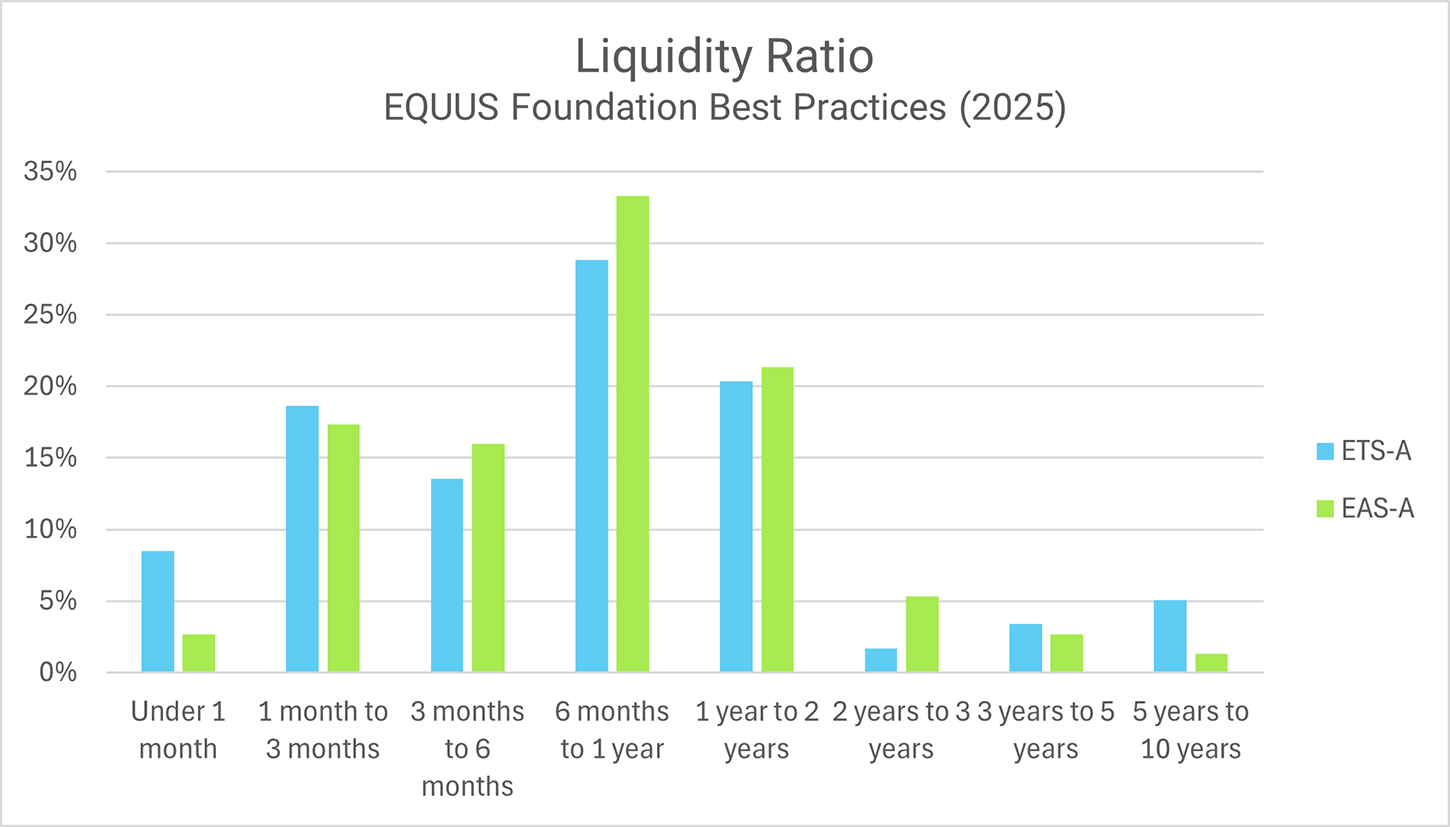
Approval of the Guardian designation may be denied if the organization's financial status over the past three to five years shows that the organization has a liquidity ratio of less than one (1) month and/or that the organization does not have sufficient cash reserves to offset net losses in any given year.
The Liquidity and Cash Reserves ratio are calculated based on the most recent financials provided by the Guardian. When the ratios are below one month, past financial statements are reviewed.
Liquid Funds Ratio =([net assets at end of year] - [fixed assets])/([total expenses]*12)
- shows the number of months of expenses that can be covered by existing assets.
Cash Reserves Ratio =([cash at end of year]/([total expenses]*12)
- shows the number of months of expenses that can be covered by existing cash.
Close X
All Guardian charities make their policies pertaining to Breeding available for public scrutiny. The EQUUS Foundation requires that the organization does not conduct breeding of equines owned or under the care of the organization that participates in the organization's programs.
Of the 128 Guardians, all have a no-breeding policy; however, there is one Guardian that utilizes a facility not owned by the charity in which the facility owner breeds.
Close X
All Guardian charities make their policies pertaining to Euthanasia available for public scrutiny.
All Guardians must meet the EQUUS Foundation policy requirements for euthanasia as follows:
• The organizations will never have an equine euthanized for space.
• The organizations may have an equine euthanized upon the recommendation of the veterinarian after all reasonable treatment options have been explored.
• The organizations may have an equine euthanized upon the recommendation of the veterinarian if the equine is a threat to itself, other equines, or people.
Close X
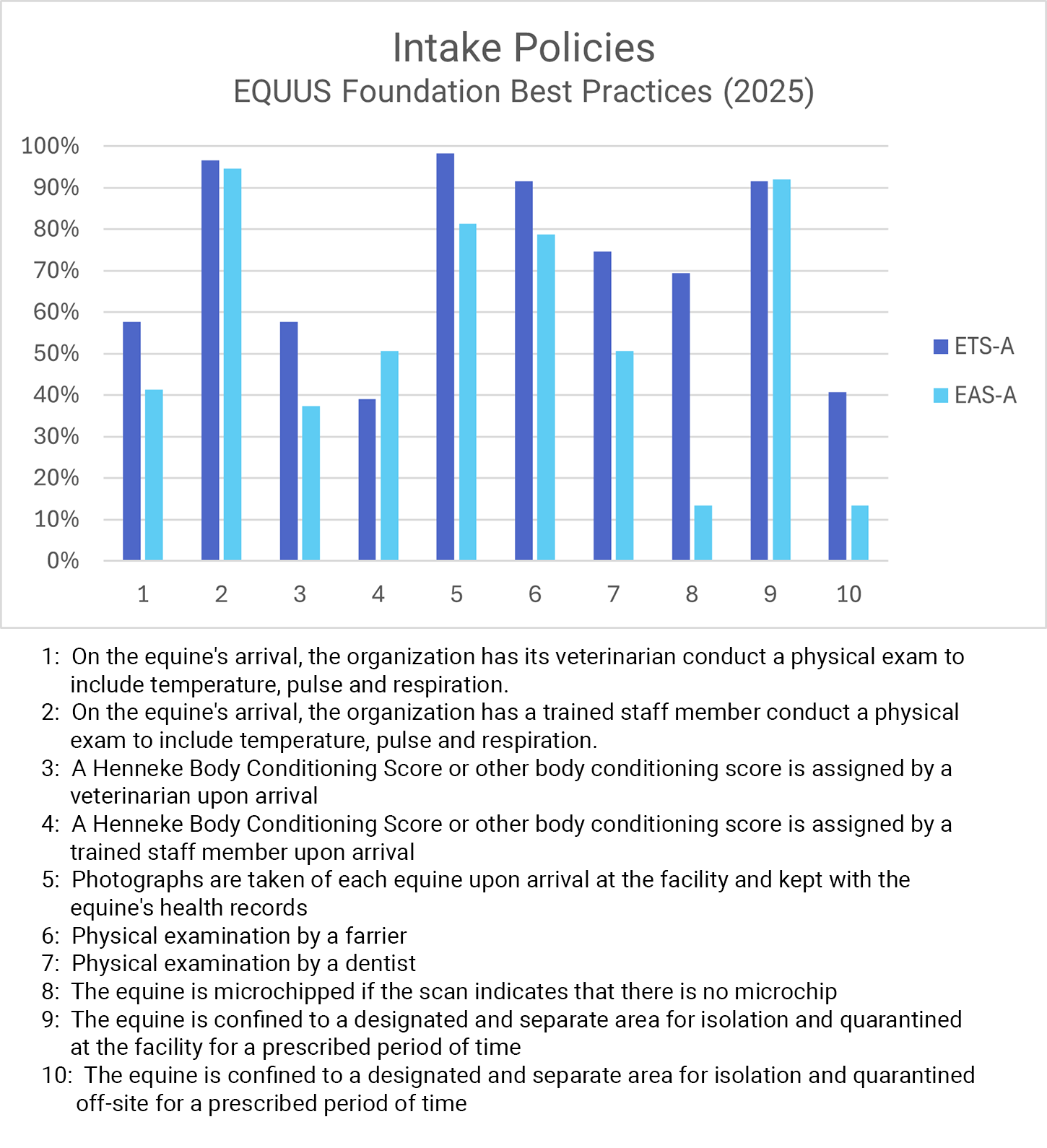
All Guardian charities make their policies pertaining to Intake available for public scrutiny.
Mentors must meet the following requirements:
• Prior to a horse (equine) being accepted and/or arriving at the facility, if the equine is acquired from the equine's owner other than by seizure or by abandonment, the owner completes a written application/contract which constitutes the agreement between the owner and the organization.
• On the equine's arrival, the organization has its veterinarian or a trained staff member assess an equine by using the Henneke Body Conditioning Score or another body conditioning score. Equines should score no less than a body condition score of 3 on the Henneke Condition Scoring Chart to be considered of adequate weight.
Prior to the arrival of an equine:
• Of the 128 Guardians, only 6% do not require that the owner complete an application/contract which constitutes the agreement between the owner and the organization when the equine is acquired from the equine's owner other than by seizure or by abandonment.
• 94% interview the owner of a potential adopter over the phone or in person vs. 70% of ETS charities when the equine is acquired from the equine's owner other than by seizure or by abandonment.
• 85% evaluate the equine where the equine is sheltered.
• 42% of Guardians require that the equine arrives with a health certificate signed by a veterinarian and dated no more than seven days prior to arrival.
• 99% of Guardians require that equines are vaccinated, and if not, they will have their veterinarian administer vaccinations. Going forward, all Guardians will be required to ensure that their equines are vaccinated on arrival and at least annually.
Intake Practices on Arrival:
Quarantine:
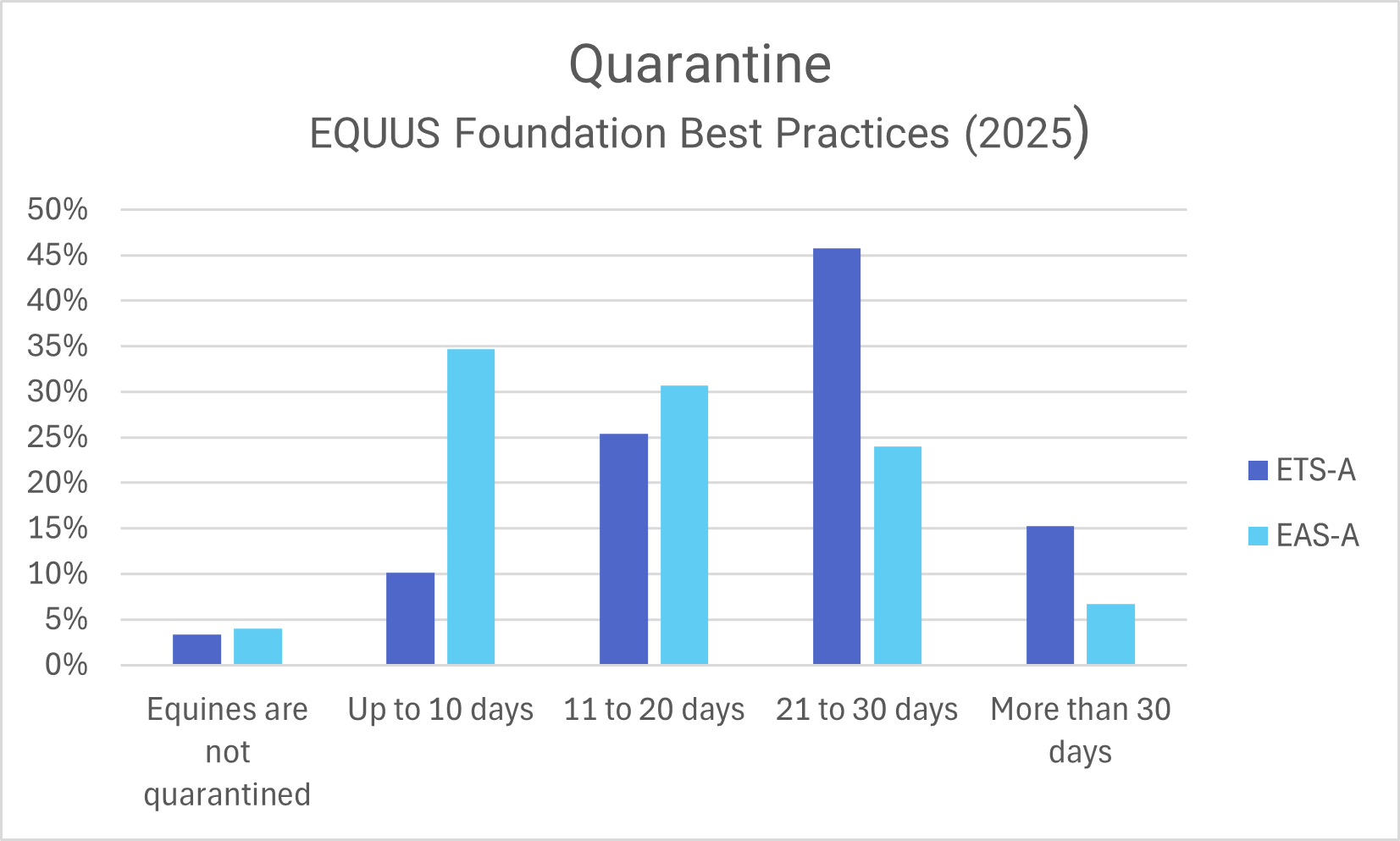
To ensure that an equine is free of contagious diseases on arrival, the organization adheres to a practice that either 1) quarantines an equine for a minimum of 7 days if the equine is arriving from a facility with minimal perceived risk or 21 days if the equine is arriving from a facility of unknown risk or 2) requires that a health certificate signed by a veterinarian and dated no more than seven days prior to arrival is provided to the organization either prior to or upon arrival of the equine attesting to the health status of the equine.
Of the 5% that do not quarantine, all require require that the equine arrives with a health certificate signed by a veterinarian and dated no more than seven days prior to arrival. 61% of ETS charities quarantine equines on arrival for at least 21 days compared to 31% of EAS charities.
Close X
All Guardian charities make their policies pertaining to Assessment available for public scrutiny.
• 89% of all Guardians have a veterinarian conduct a physical exam of an equine at least annually.
• 91% of all Guardians have either their veterinarian or a trained staff member update the equine's Henneke Body Conditioning score or other body conditioning score annually.
Mentors must meet the following requirements:
• At least annually, the organization has its veterinarian conduct a physical exam of all equines under the organization's care with a length of stay of 365 days or more.
• At least annually, the organization assesses an equine by using the Henneke Body Conditioning Score or another body conditioning score.
Weight Carrying and Workload Limitations:
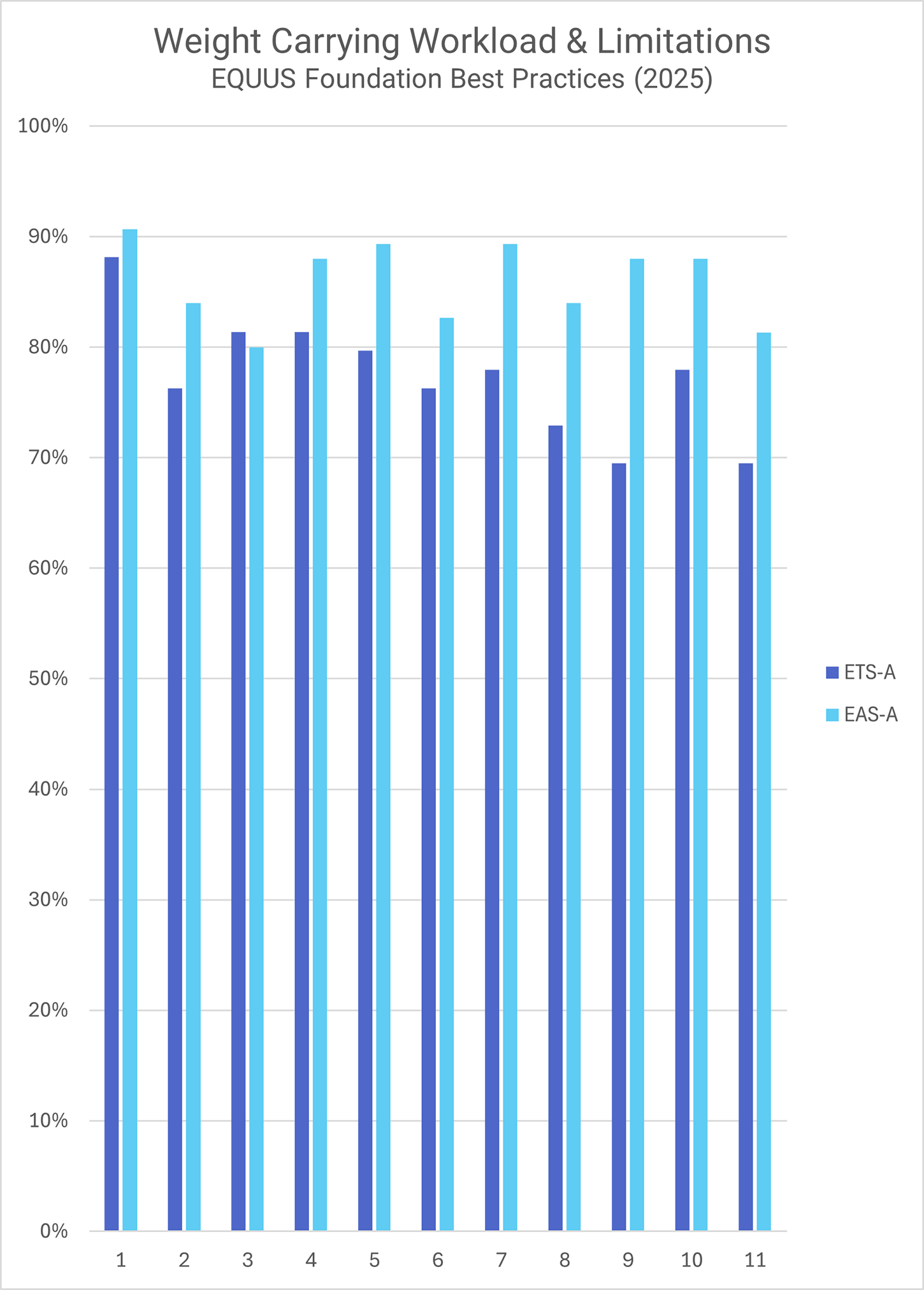
The charities where riding is a key component, which represents 87% of all Guardians, have a mechanism in place to assess the weight-carrying and workload limitations for each equine to include but not limited to evaluating the limitations at least annually and maintaining a written record for each equine that documents the results of each evaluation of weight-carrying and workload limitations.
1. Equine age, weight, breed, body condition, fitness, balance, health and soundness
2. Equine conformation to include the top line, length of back, strength and width of loin, bone density (measured by the circumference of the cannon bone just below the knee)
3. Size, shape, condition and angle of the hooves
4. Participant weight, height, body proportions, balance, fitness and riding skills as well as behavioral issues and safety concerns
5. Weight and proper fit of the saddle and other equipment
6. Terrain and footing in the working environment
7. Duration and frequency of working sessions, as the frequency with which an equine is subjected to maximum weight carrying and/or workload
8. Nature and pace of work, repetitive or varied, radius of turns, degree of incline and regularity of footing when equine is subject to maximum weight-carrying capacity
9. Break intervals between working sessions
10. Temperature and/or weather conditions
11. Seasonal impact on the equines' workload and weight-carrying capabilities and limitations
Skills and Behavior Assessments:
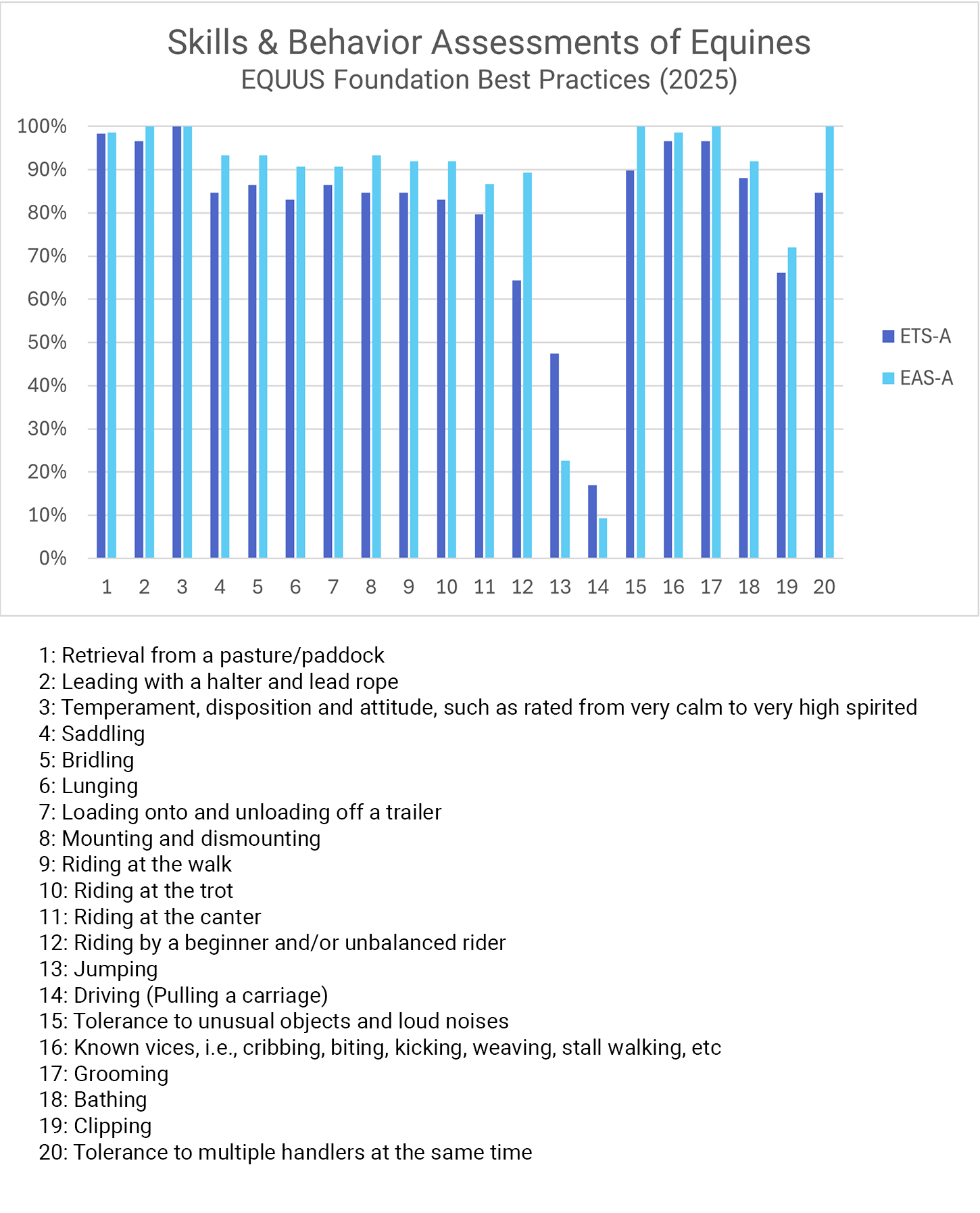
All Guardians assess equines initially and on an ongoing basis for skills and behaviors.
Close X
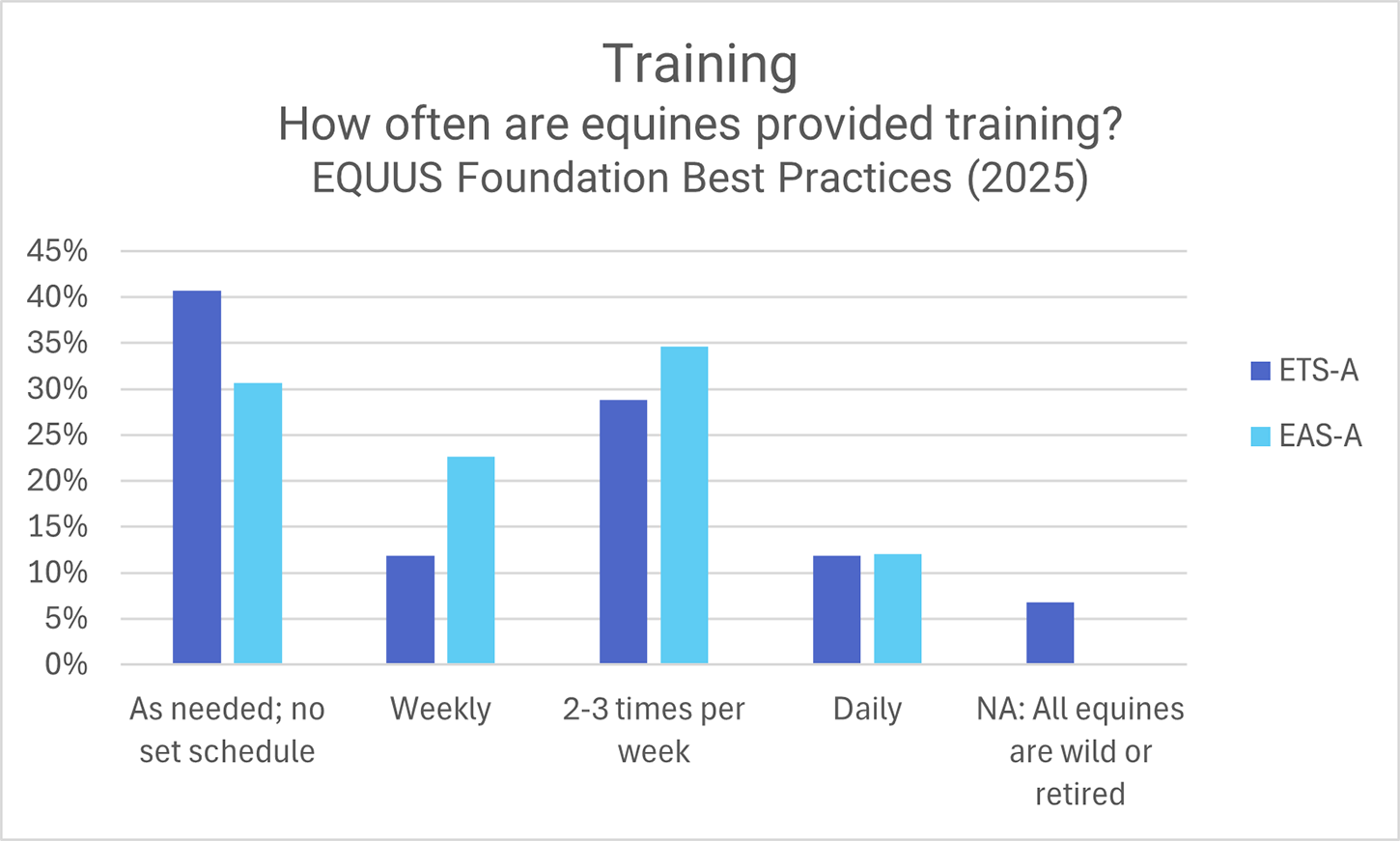
How often equines are providing training varies widely with 35% having no set schedule. 11% train daily; 34% train 2 to 3 times weekly and 17% train weekly. 3% do not undertake equine training because they are either only providing sanctuary for aged or infirm equines or they care for only wild/feral equines.
Close X
All Guardian charities make their policies pertaining to Re-homing available for public scrutiny.
The EQUUS Foundation requires all Guardians that re-home horses for any reason to require all potential adopters/purchasers to complete a written contract which constitutes the agreement between the potential adopter/purchaser.
The EQUUS Foundation further requires that such contract state or reflect that any individual or organization in possession of the equine as of the date of the agreement and any time thereafter is bound to not sell the equine at auction for slaughter or allow the equine to be sold, transferred, released, or otherwise placed into possession of any person or organization that will cause or allow the equine to be sold at auction for slaughter.
Of the 128 Guardians, 84% re-home horses; 14% offer life-time care for their horses and do not re-home for any reason; and 2% do not have the authority to re-home as all the horses under their care are leased and not owned by the organization in which case, the horses would be returned to their owners.
Of the 84% that re-home horses, the re-homing practices vary. The practices also vary depending on whether the program focus is ETS vs. EAS, specifically whether or not an organization will re-home to a first time equine owner; only 10% of ETS charities will re-home to a first time buyer compared to 52% of EAS charities.
Of the 85% that re-home horses, the requirements that are included in the organization's re-homing agreement vary.
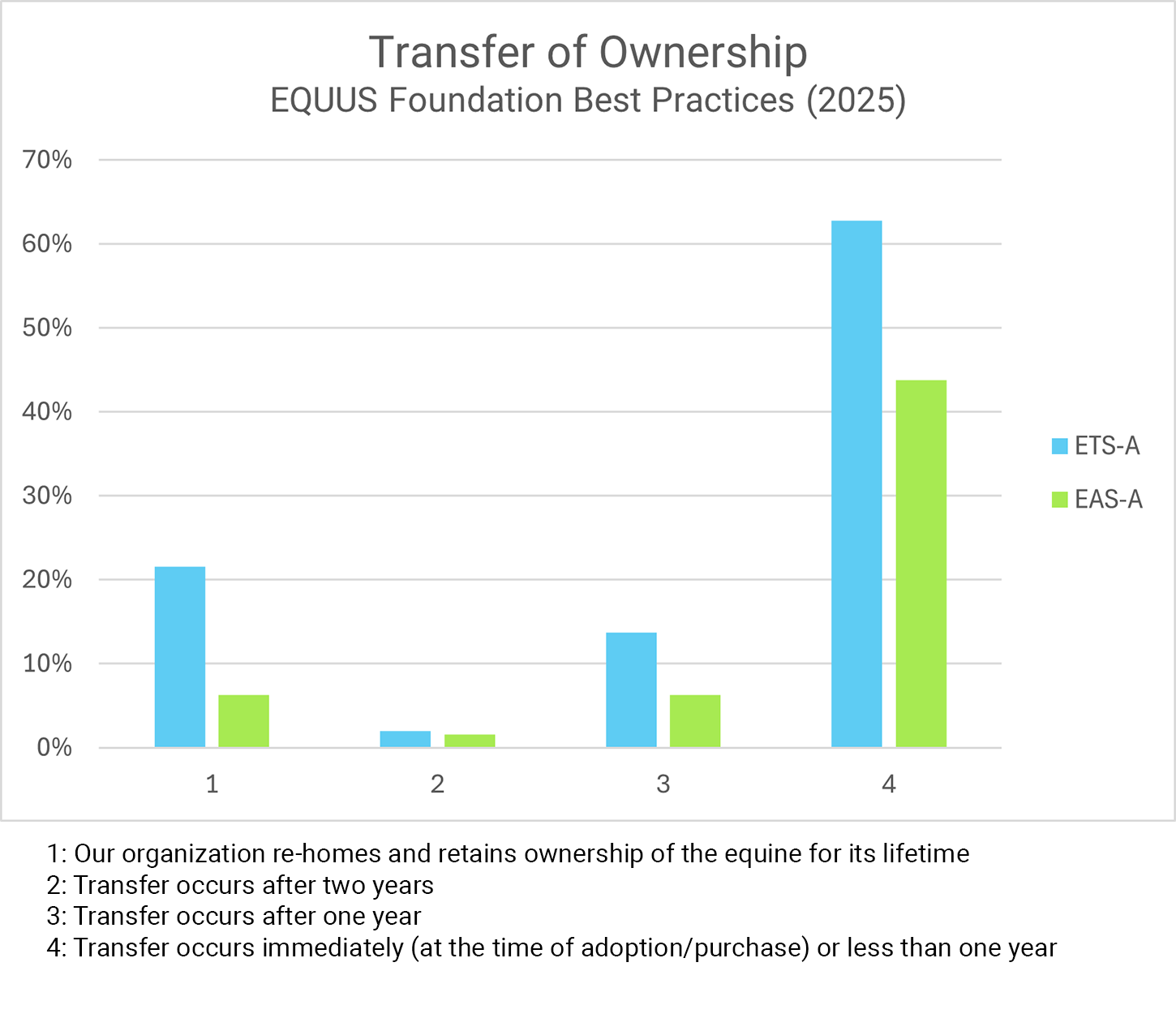
Transfer of Ownership:
Of the charities that re-home, transfer of ownership is similar for ETS and EAS charities.
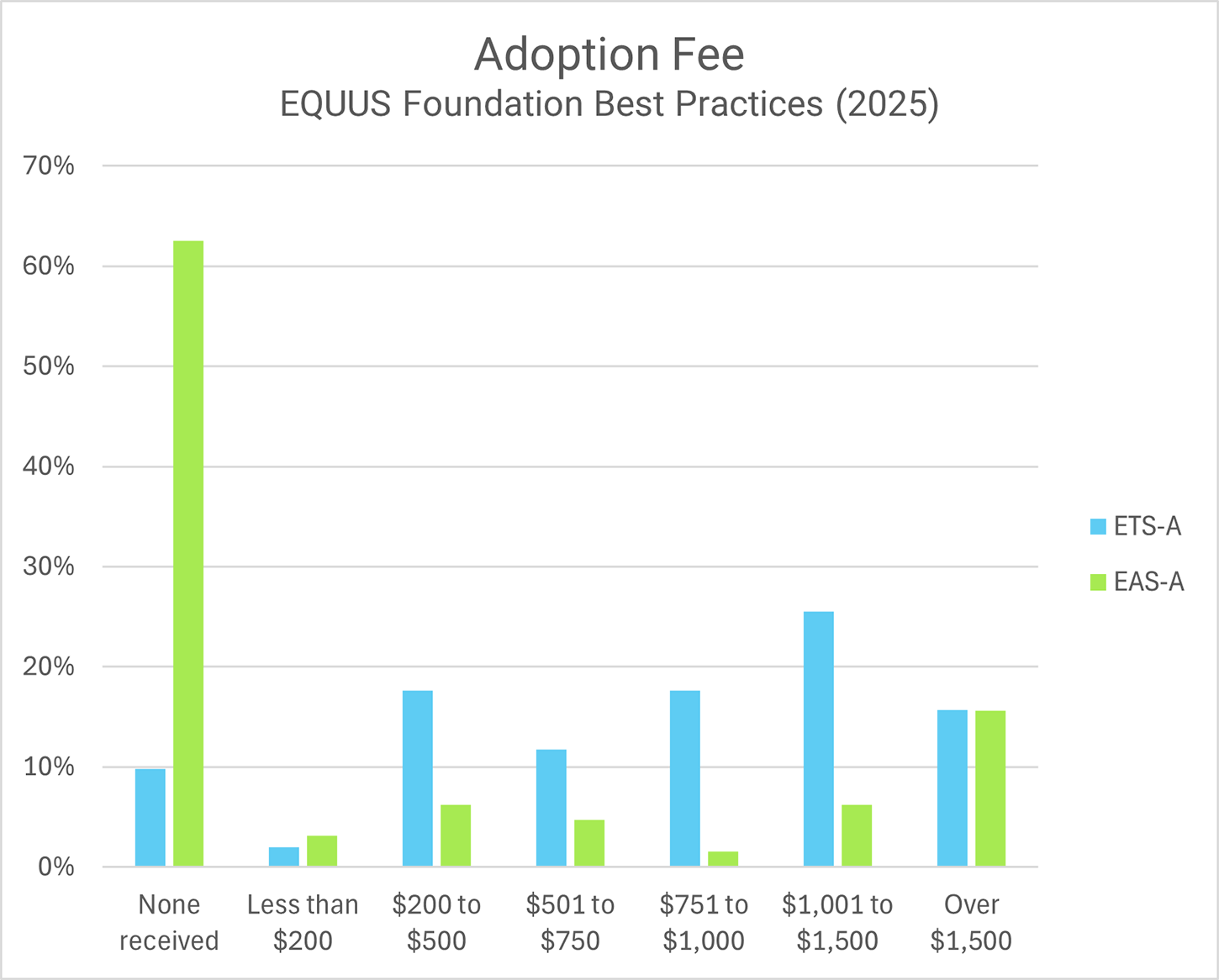
Adoption Fee:
Of the charities that re-home, the adoption fee varies significantly between ETS and EAS charities with 63% of EAS charities charging no fee compared to 10% of ETS charities.
Close X
The EQUUS Foundation requires its Guardians to provide a census of all their equines including breed, gender, age, intake source, intake date, departure date and departure reason, i.e., adopted, transferred, returned (if leased), euthanized, or deceased.
To attain the Guardian designation, the organization must be responsible for the care of at least 3 equines. To attain the Mentor Accreditation, the organization must be responsible for the care of at least 5 equines.
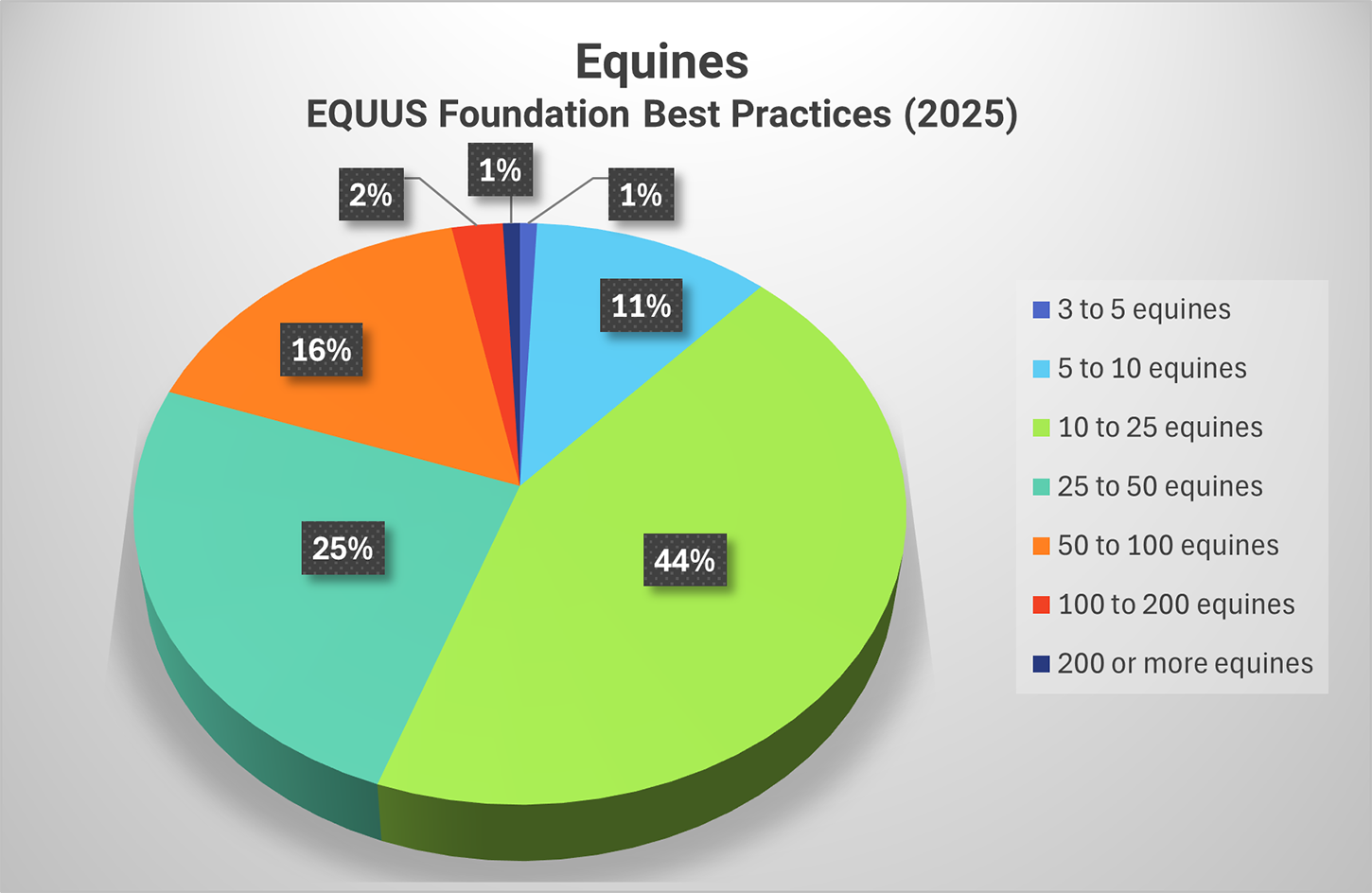
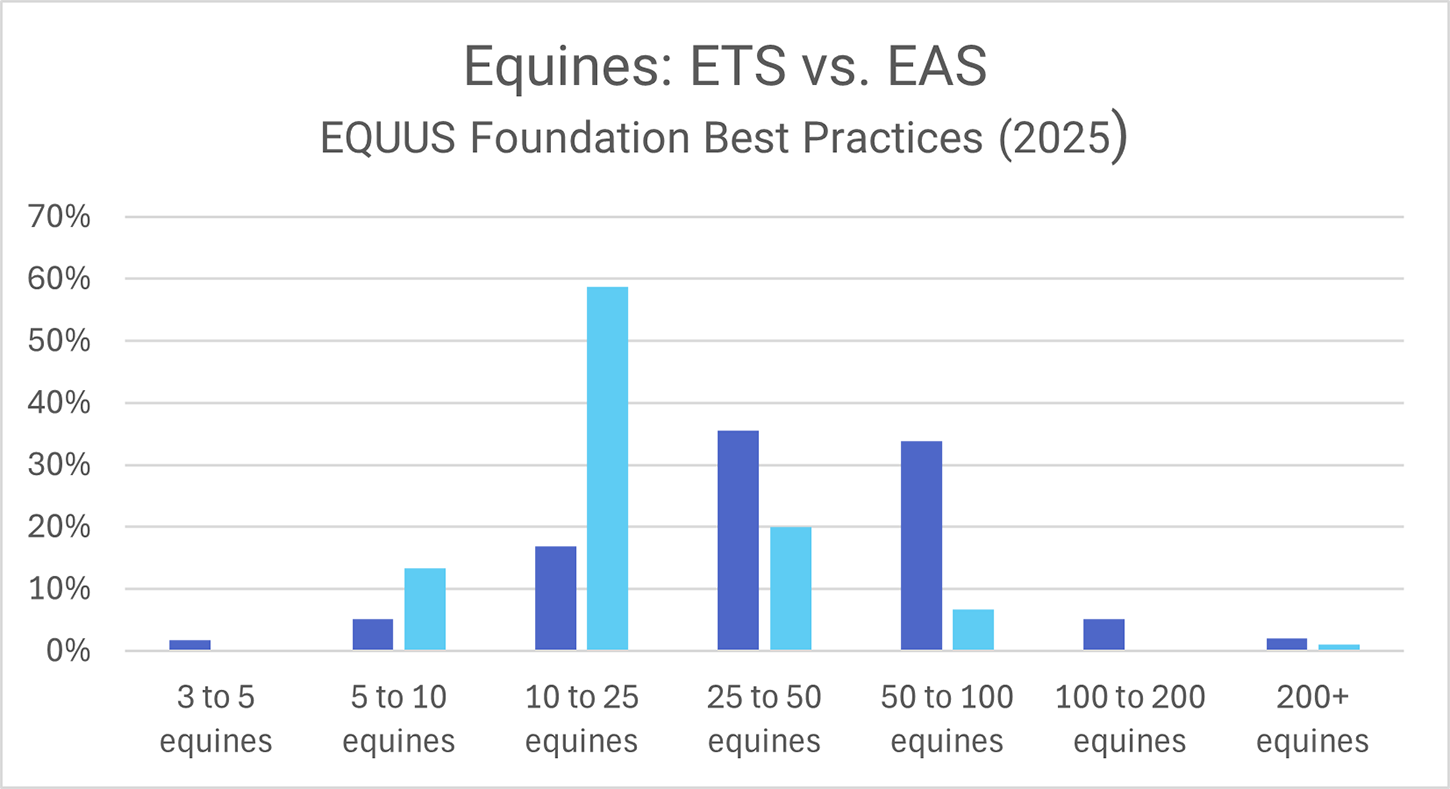
During 2024, the Guardian charities were responsible for the care of 4,228 equines. 43.75% of the Guardian charities cared for at least 10 to 25 equines.
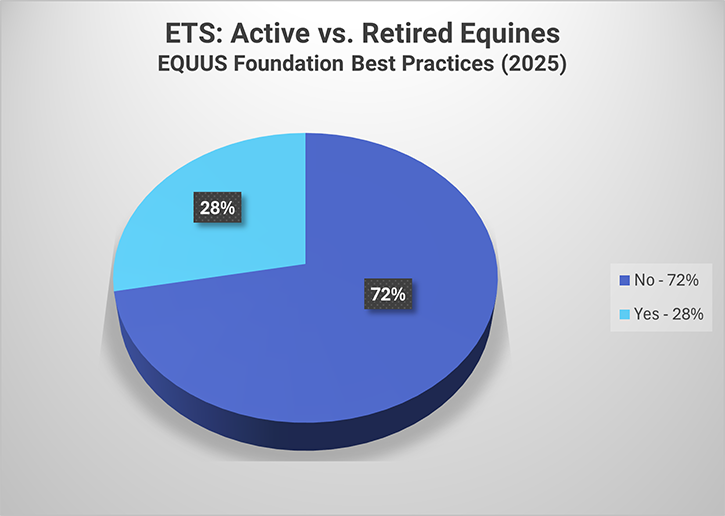
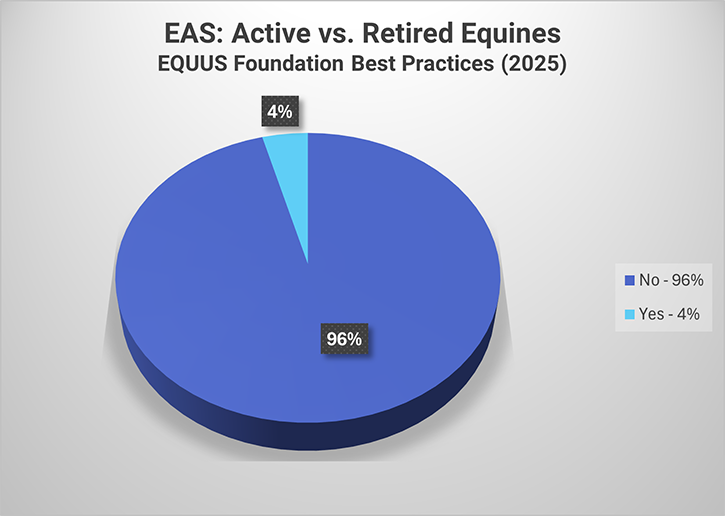
The census also includes whether or not the equine is retired, i.e., not adoptable in the case of ETS charities, or in the case of EAS charities, not participating in EAS services. Of 4,228 equines, 862 were designated as "Retired".
There are distinctive differences between ETS and EAS charities. EAS charities generally do not provide lifetime care for their equines. Both ETS charities that provide retirement/sanctuary services and equine charites that provide adoption services provide lifetime care for equines.
Of the total number of retired equines, 59% are cared for by equine charities providing adoption; 35% are cared for by equine charities providing sanctuary and retirement and 7% are cared for by equine charities providing Equine Assisted Services.
Close X
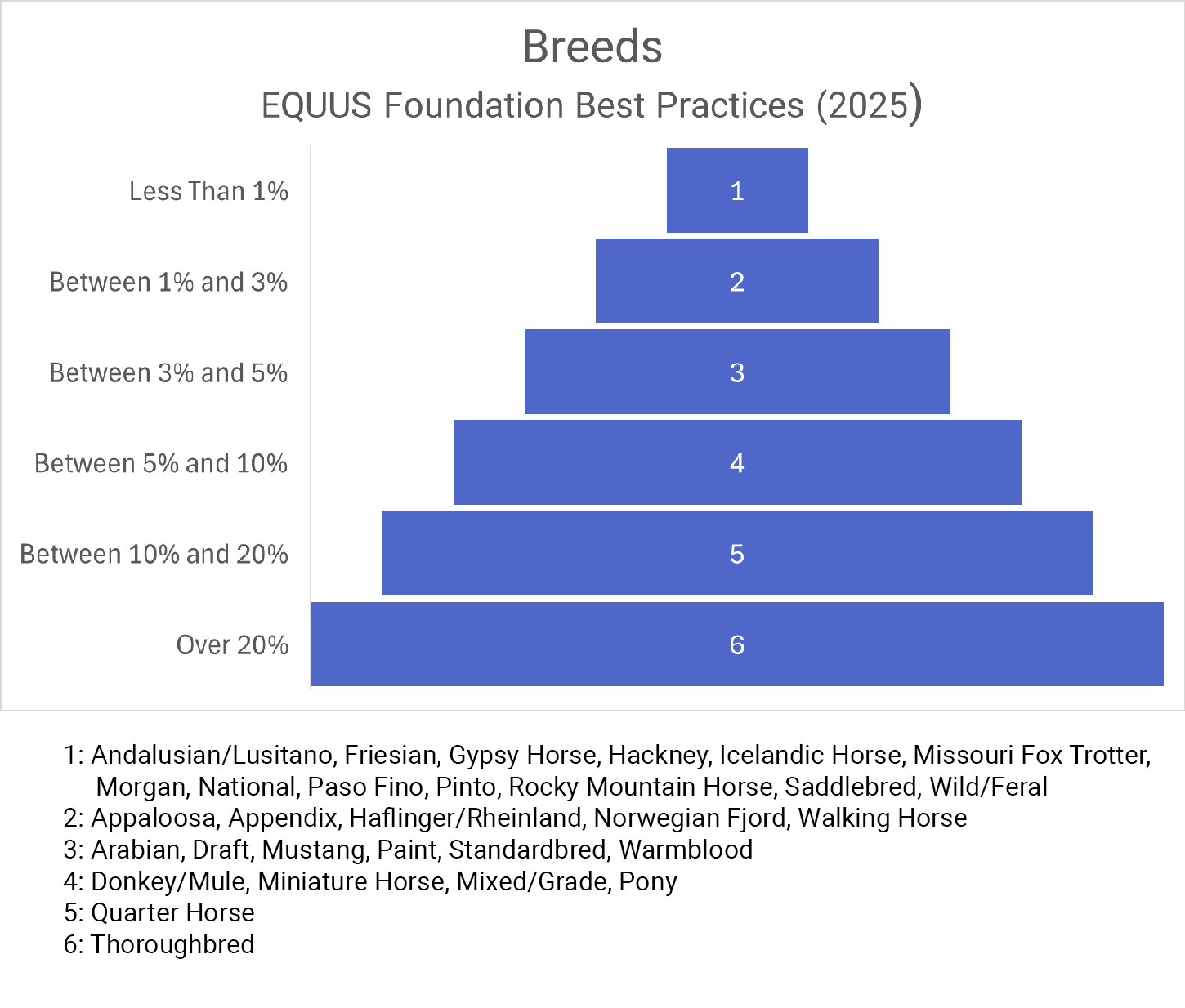
The 128 Guardians are caring for over 30 breeds with Thoroughbreds representing over 23% followed by Quarter Horses at 14%.
Close X
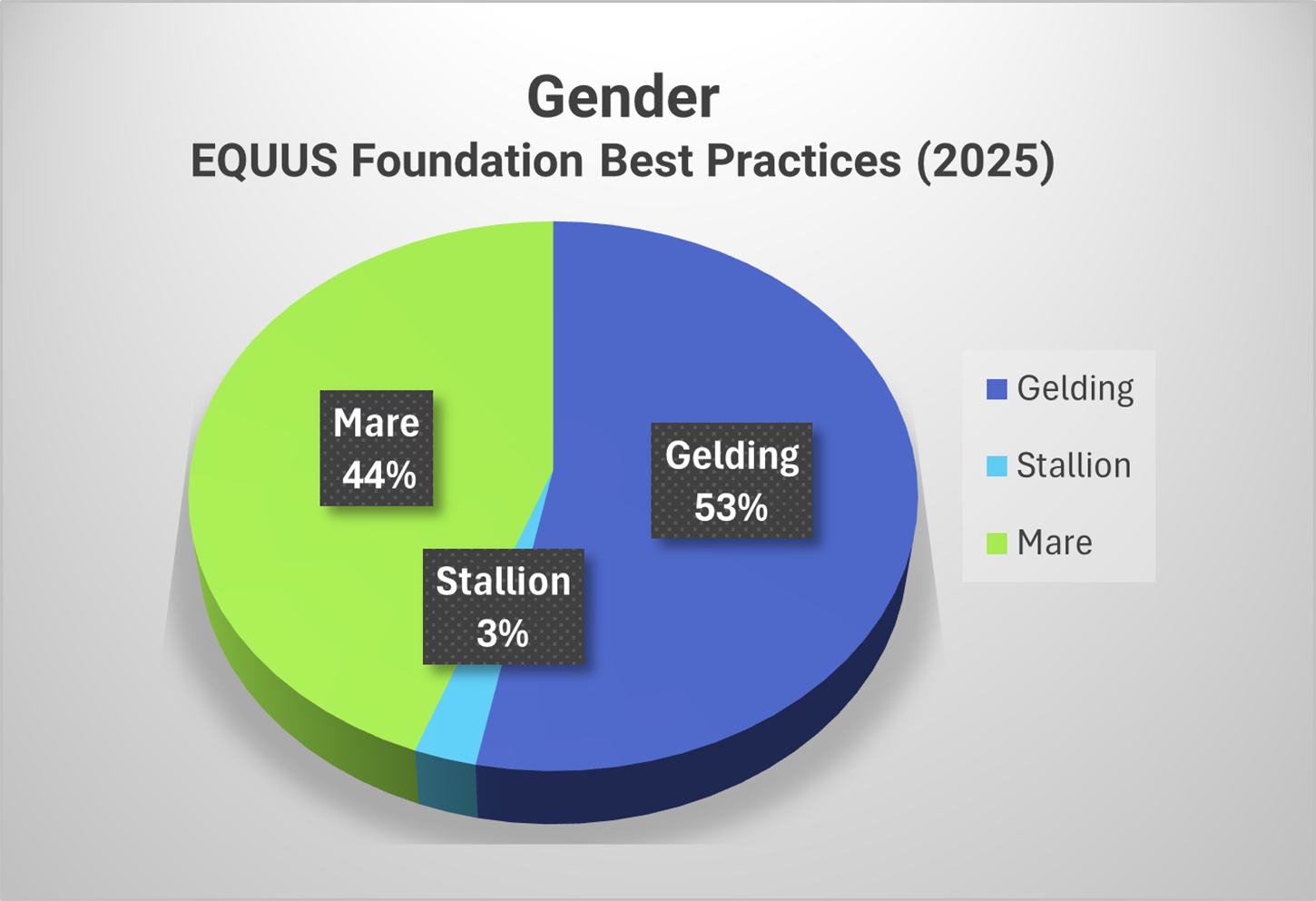
Of the 4,228 equines cared for by Guardian charities, 53% were geldings; however, the Guardians that took in stallions gelded them after intake, increasing the percentage of Geldings from 53% to 56% compared to 44% Mares. There was no appreciable difference between ETS and EAS Guardians.
Note: A female Mule/Donkey is recorded as a Mare and a male Mule/Donkey is recorded as either a Stallion or Gelding
Close X
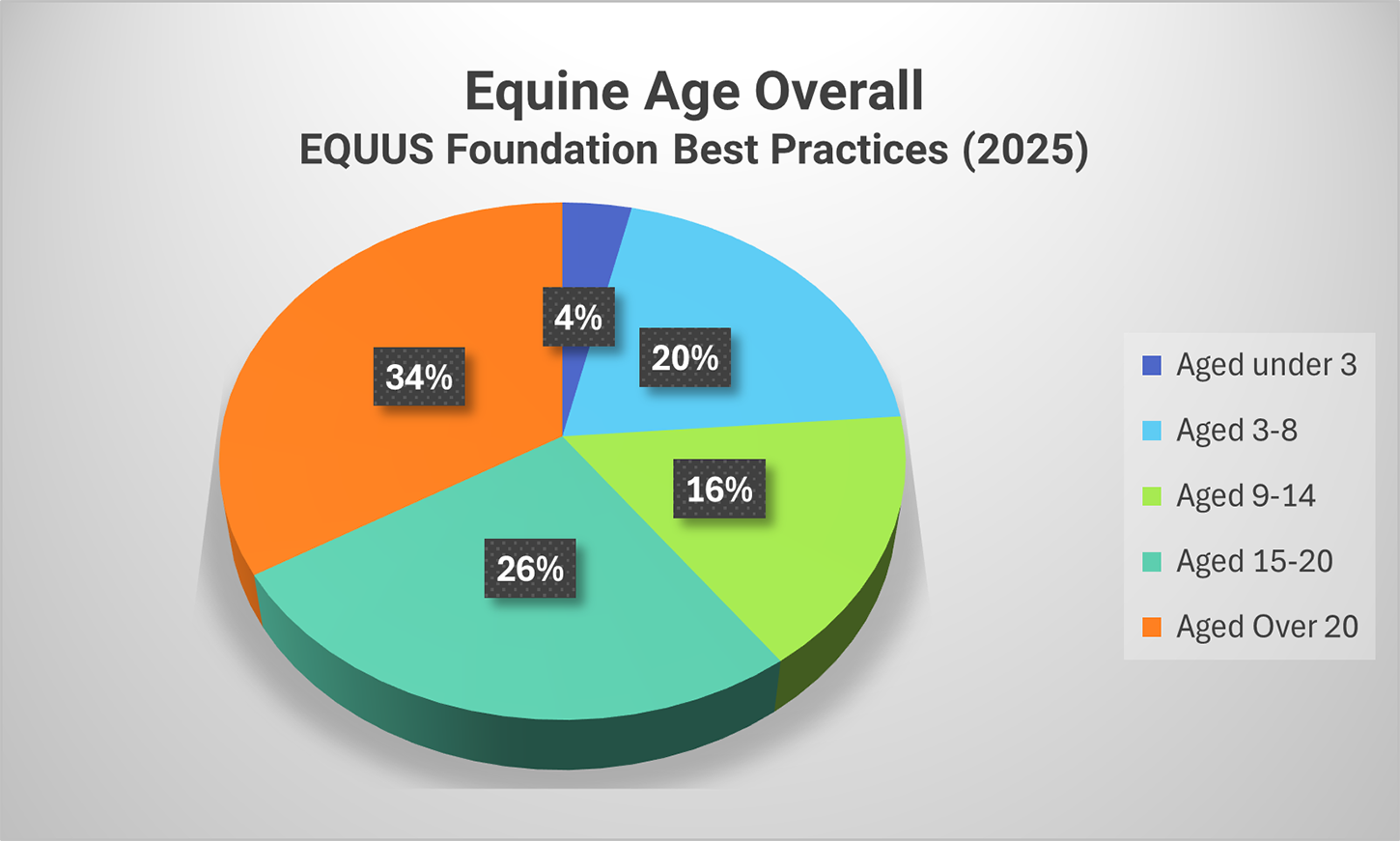
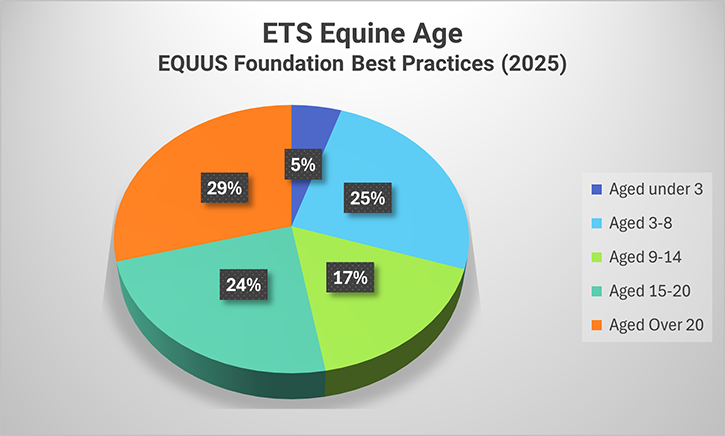
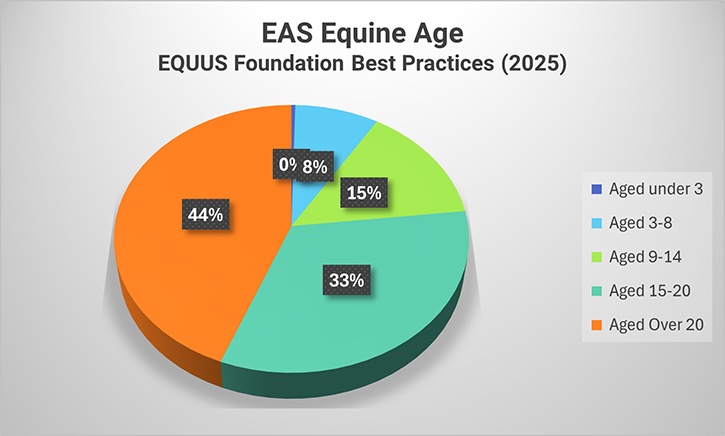
Of the 4,228 equines cared for by Guardian charities, ages range from under 1 year to 3 equines aged 42. ETS data shows that 29% of the equines were under 9 years old compared to 12% for EAS charities.
Close X
Of the 4,228 equines cared for by Guardian charities, there were significant differences in the intake sources of ETS equine charities vs. EAS equine charities. The largest intake source for ETS charities was by surrender at 36% followed by donated at 17% and seized at 15% totaling 68% compared to EAS charities with the largest intake sources being donated at 30%, leased at 28% followed by purchased at 23% totaling 81%. Adoption returns for ETS charities were 8% compared to less than 1% for EAS charities.
INTAKE/ACQUISITION SOURCES:
Abandoned: The ownership and custody of the equine is transferred to the organization as a result of the equine being abandoned by the owner or the owner was unable to be located.
Adopted from Rescue Organization: The ownership and custody of the equine is transferred to the organization by an organization specializing in the re-homing of equines in transition utilizing an adoption document.
Auction: The ownership and custody of the equine is transferred to the organization by acquiring the equine at an auction.
Born: The equine was born at the facility.
Donated: The ownership and custody of the equine is transferred to the organization by its owner/trainer/responsible agent utilizing a donation document.
Kill Pen: The ownership and custody of the equine is transferred to the organization by acquiring the equine from a kill pen.
Leased: The ownership of the equine is maintained by the owner/trainer/responsible agent; the custody and responsibility for the shelter and care of the equine is transferred to the organization utilizing a lease document.
Owner-Assist: Only for ETS (Equine Transition Services) Programs: The ownership and custody of the equine is retained by the owner; the organization provides Owner to Owner Transition Services to assist with re-homing.
Purchased from Owner: The ownership and custody of the equine is transferred to the organization by its owner/trainer/responsible agent utilizing a purchase document.
Returned: The equine was previously a part of the organization, was adopted, and ownership and custody of the equine has been transferred back to the organization.
Seized: The ownership and custody of the equine is transferred to the organization as a result of the equine being seized by law enforcement or another agency and removed from the owner.
Surrendered: The ownership and custody of the equine is relinquished to the organization by its owner/trainer/responsible agent with or without the use of an intake document.
Transferred in from another facility: The custody of the equine is transferred within an organization with no change in ownership or from one organization to another non-profit or foster organization to provide retirement, retraining, rehabilitation and/or adoption services with a change in ownership.
Close X
Comparing ETS and EAS charities, there is no appreciable differences in the number of equines that are transferred or returned, euthanized or deceased; as expected, the number of equines that are adopted is significantly higher for ETS charities vs. EAS charities at 37% adopted for ETS compared to 5% for EAS.
DEPARTURE REASONS:
Adopted/Sold: The custody and/or ownership of the equine is transferred to a private individual or an organization utilizing a purchase or adoption document.
Transferred: The custody of the equine is transferred from one organization to another organization with the receiving organization granted temporary custody with no change in ownership.
Returned: The ownership and custody of the equine is returned to the equine's owner.
Euthanized: The equine was humanely euthanized.
Deceased: The equine died.
Close X
Of the equines 4,228 equines under the care of the 128 Guardians, 2,813 were defined as "adoptable", i.e., not retired, including both ETS and EAS charities; however, for ETS charities, 1,680 were considered "adoptable" and 1,017 were adopted yielding an overall 61% adoption rate.
The adoption rate is based on the actual number of equines adopted compared to the total number of equines that were adoptable for each organization.
In comparing the adoption rate for ETS charities, 20% of the charities, including sanctuaries and retirement facilities, had no adoptions. Of the remaining 80%, the charities had adoption rates between 30% and 50%.
Close X
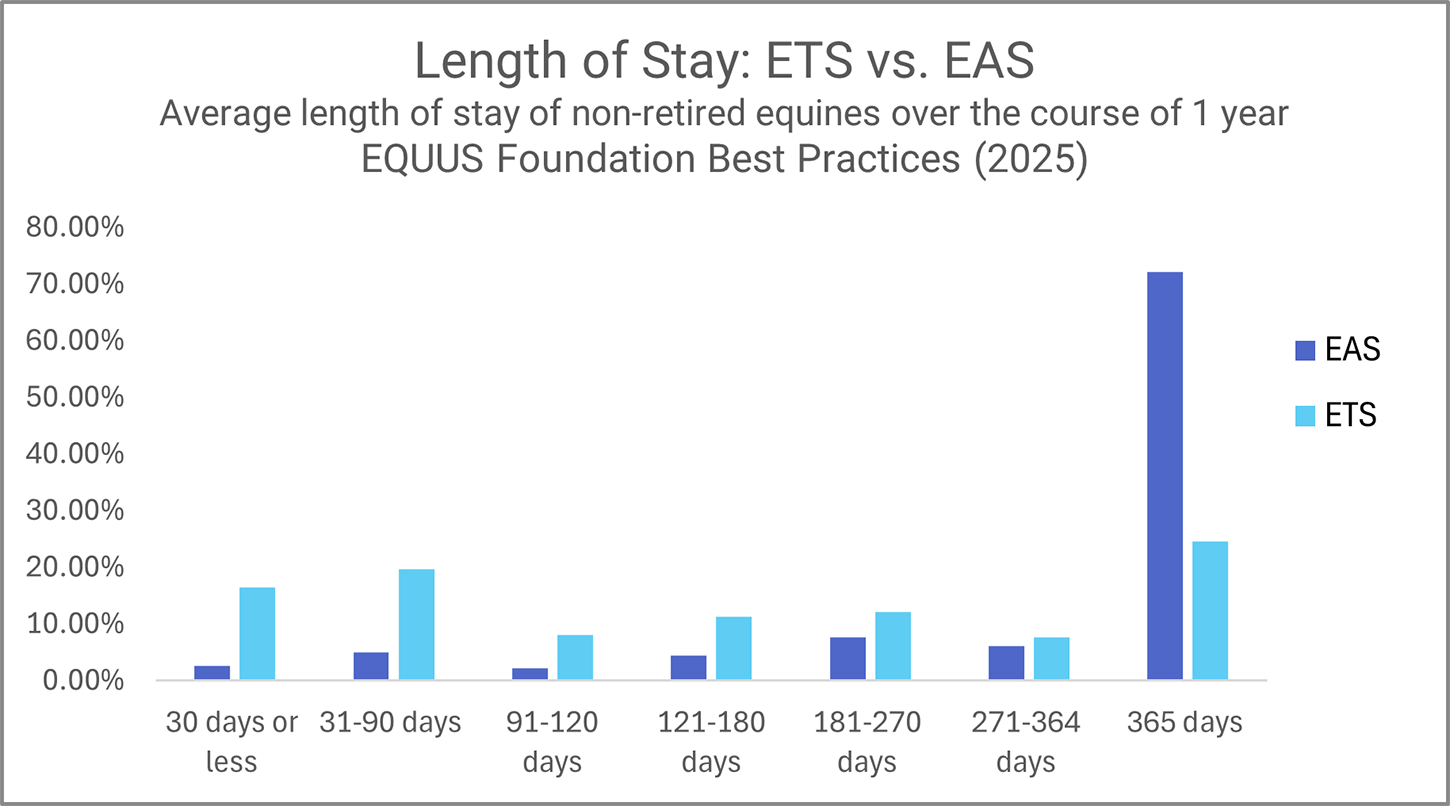
Length of stay is calculated annually based on the intake date and departure date or the end of the calendar year if the equine remains under the care of the organization for each equine. For EAS charities, 72% remain under the care the organization for 365 days compared to ETS charities, where 25% remain under the care of the organization, including retired equines.
For ETS charities, 37% of the equines had a length of stay of under four (4) months, another 11% had a length of stay of less than six (6) months and another 12% had a length of stay of less than nine (9) months.
For ETS charities, comparing length of stay to adoption time, 29% of the equines were adopted in under four (4) months, 8% more were adopted in less than six (6) months and another 8% were adopted in less than nine (9) months.
Close X
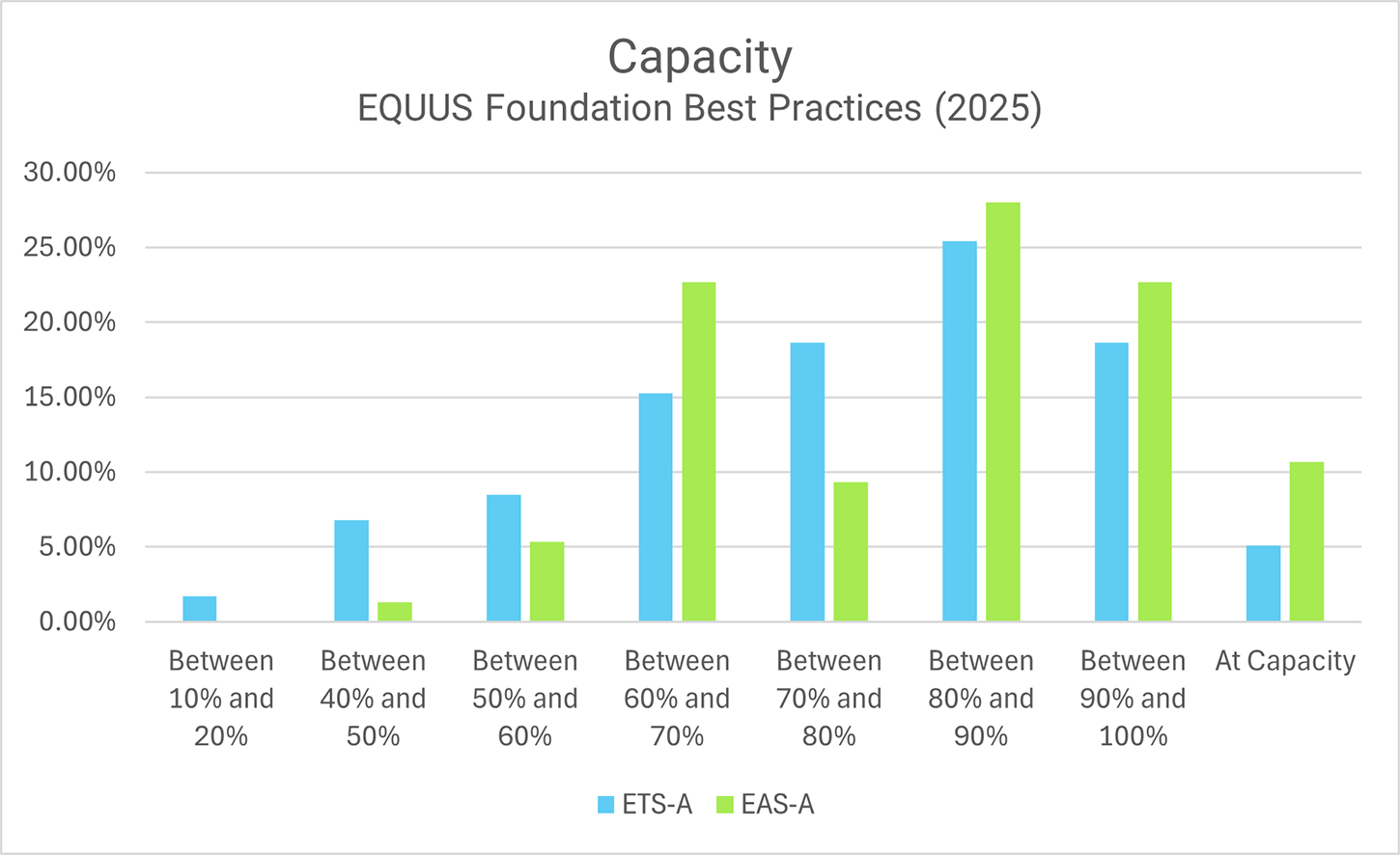
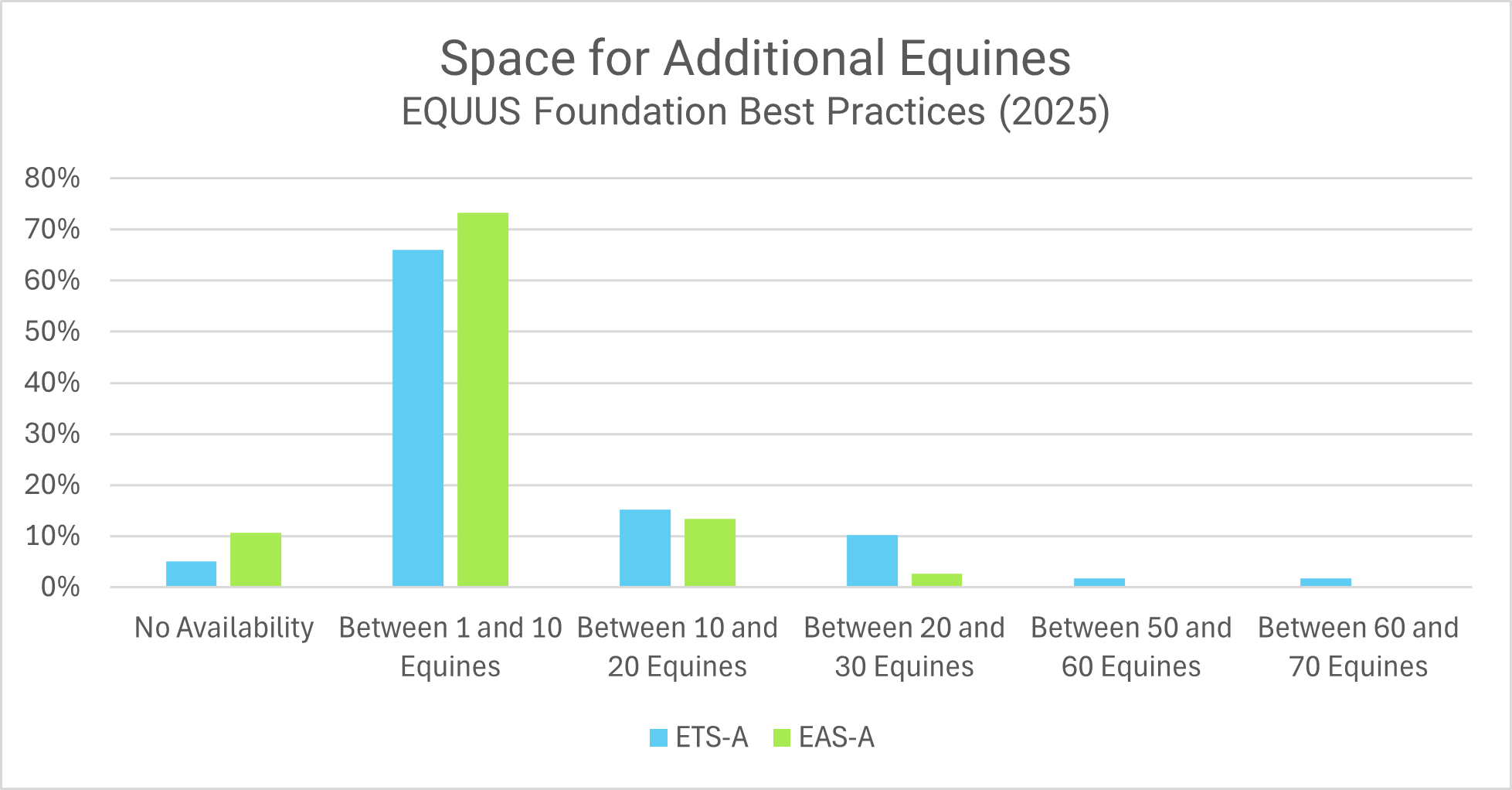
Capacity is calculated based on the total number of horses under the care of the organization compared to the organization's maximum capacity.
Space for available horses is calculated based on the organization's maximum capacity less the total number of horses under the care of the organization. Based on the equine census for the calendar year 2024, the 128 Guardians had the physical space to take in over 1,000 horses; the 59 ETS charities had the physical space to take in over 600 horses.
Close X
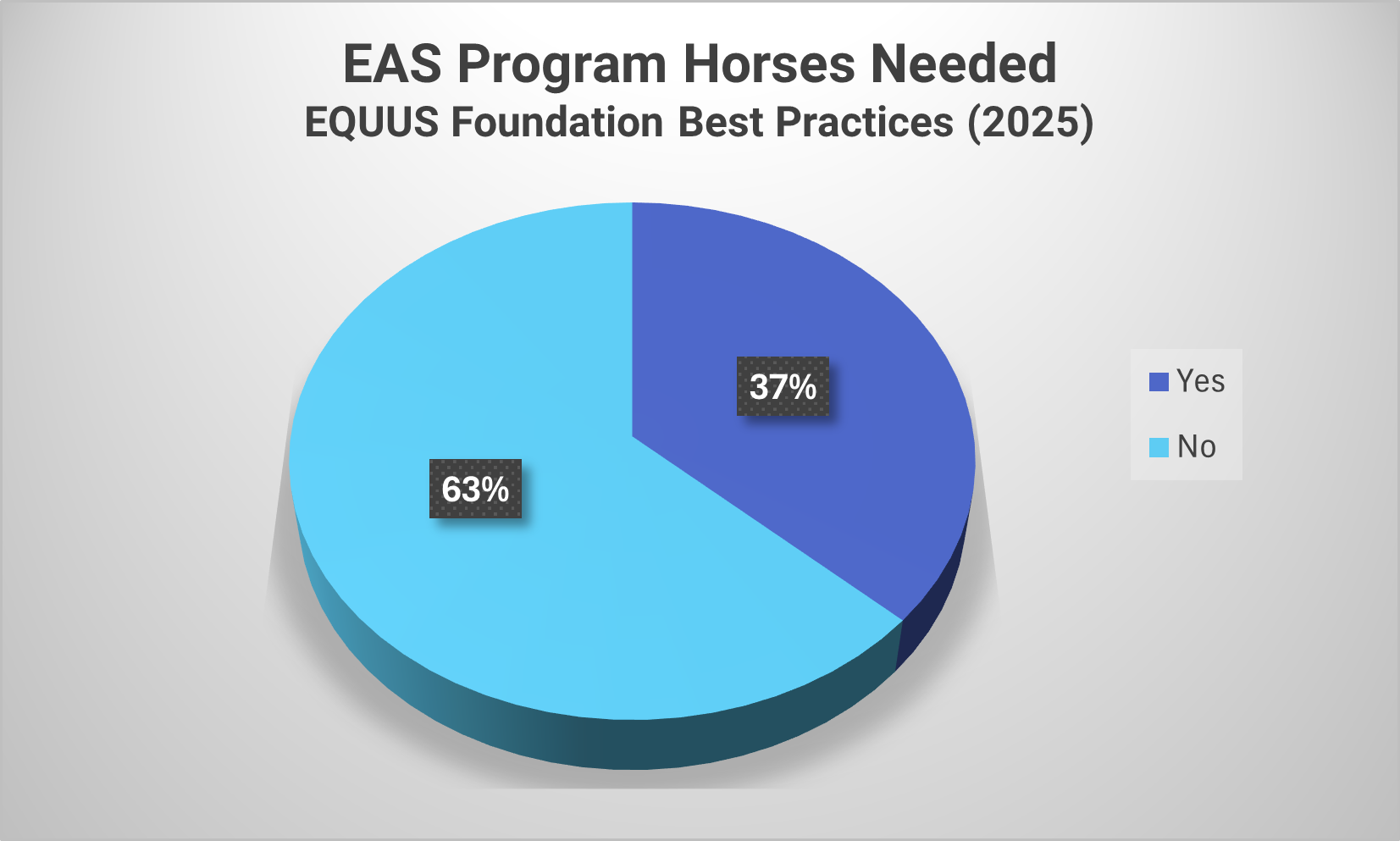
Of the 75 EAS Guardians, 28 (37%) are actively searching for program horses. The EQUUS Foundation offers a unique program called "Safe Landings" which lists the specific equine charities in need of program horses. Safe Landings also provides resources to owners who are looking to re-home their horses.
Close X
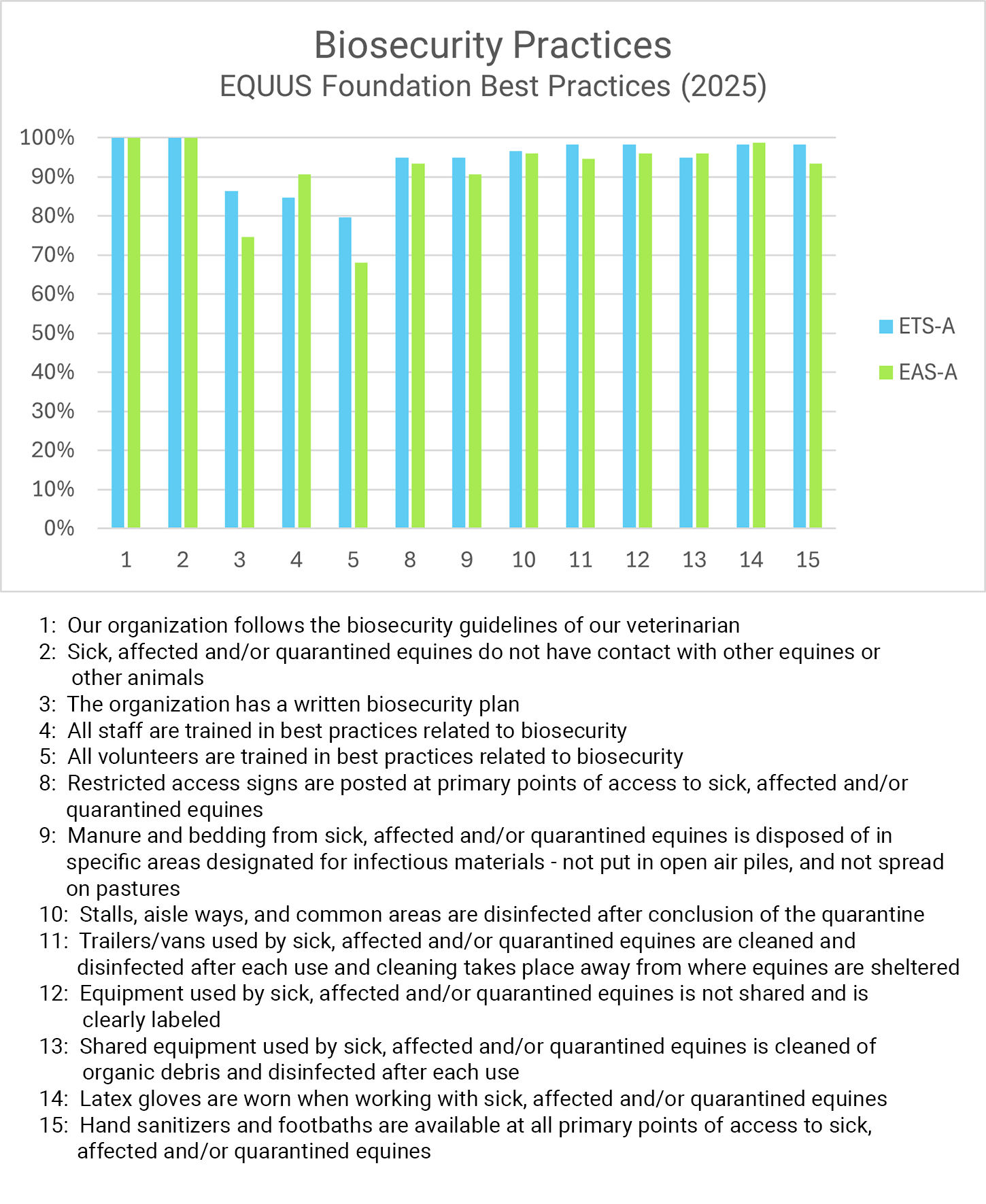
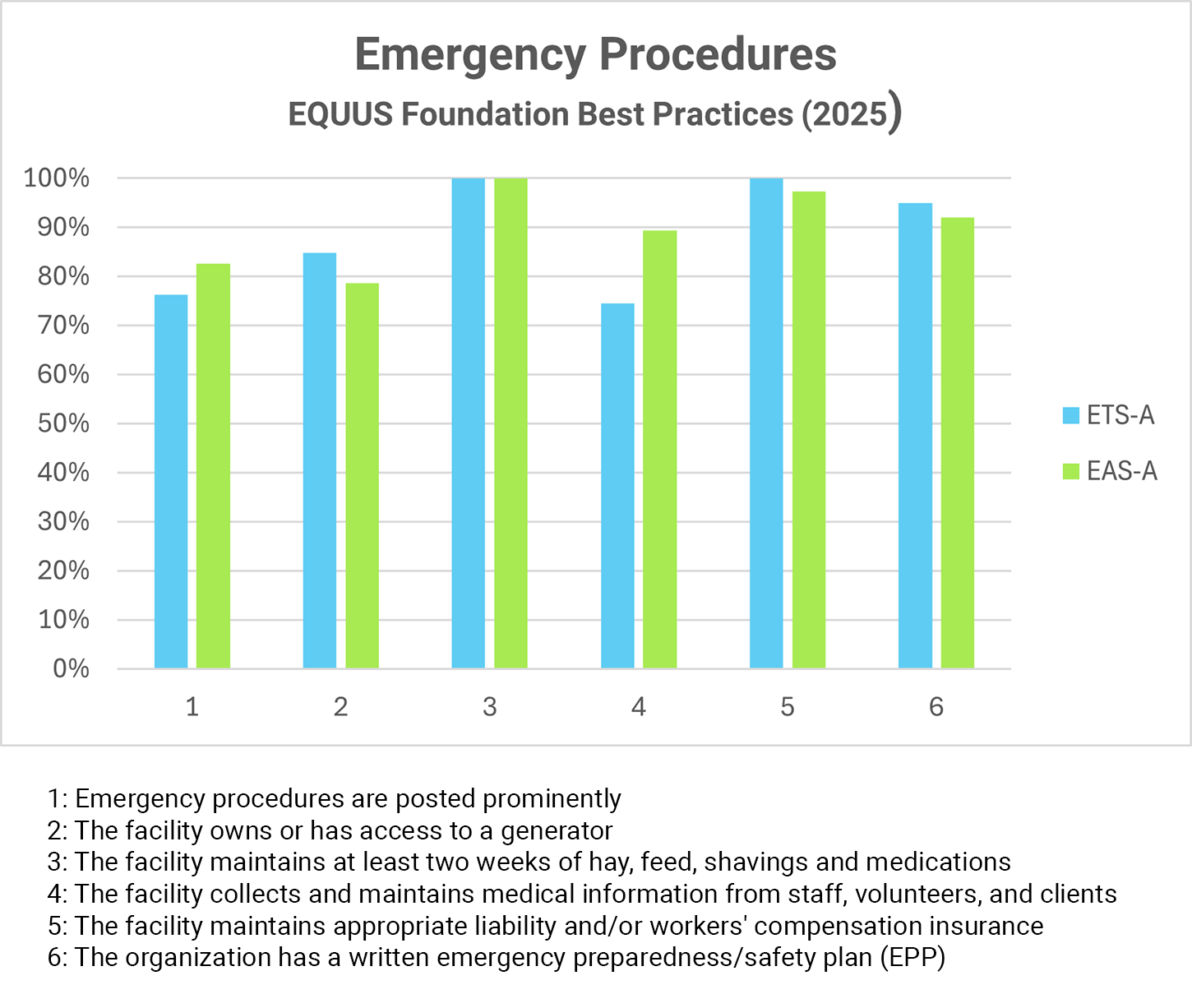
All the charities post their emergency contacts, including veterinarian contact information conspicuously in easily accessible locations. All the charities also maintain at least two weeks of hay, feed, shavings and medications.
Additional practices are in place to help prevent emergencies. For those charities that permit smoking, smoking is permitted in designated areas only and there is signage. Going forward, all Guardians will be expected to keep aisles and doorways clear in structures where equines are stalled.
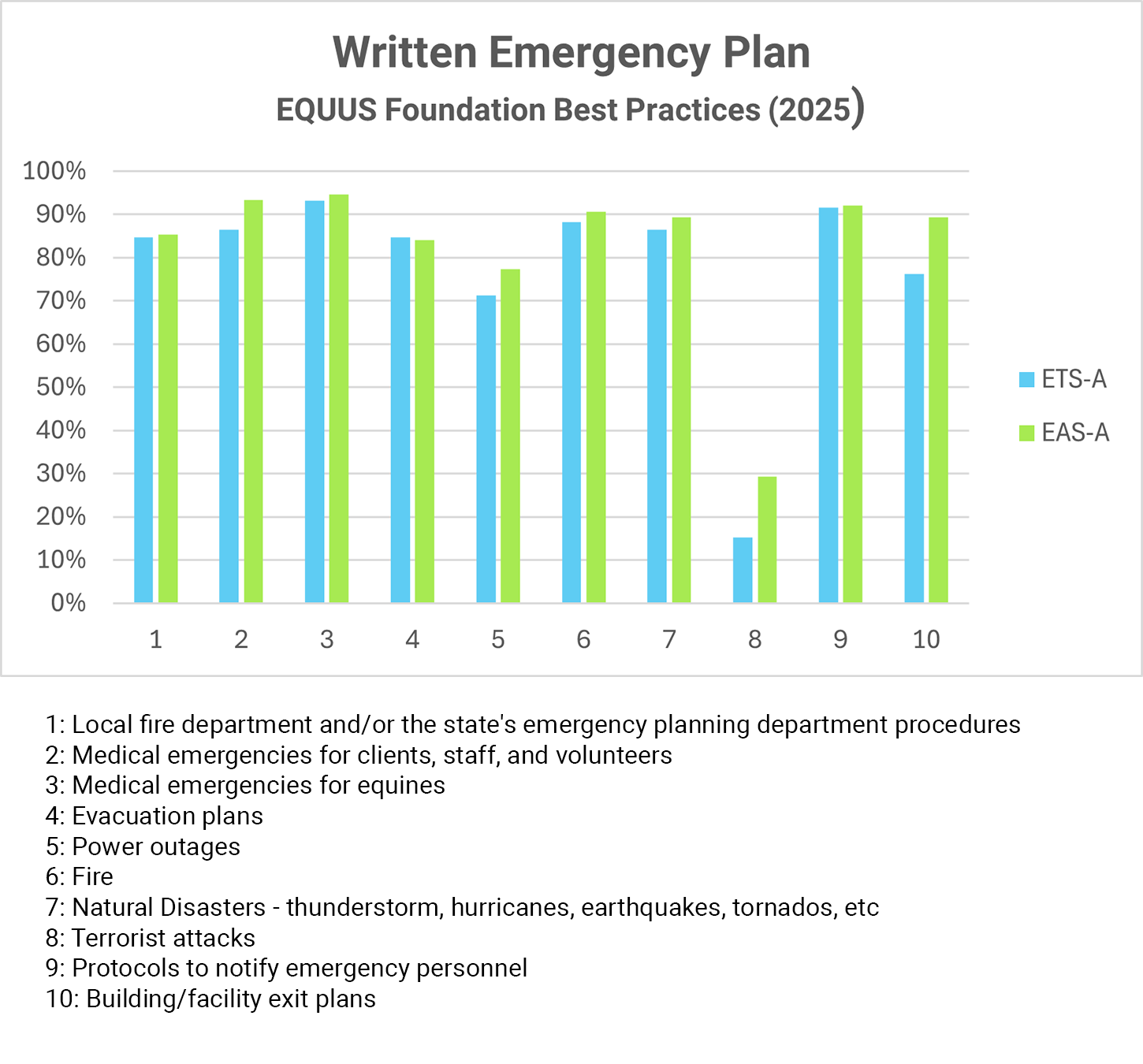
93% of the charities have a written Emergency Preparedness Plan (EPP); 95% of ETS charities have a written plan versus 92% of EAS charities. Of those charities, there are no appreciable differences between ETS and EAS charities in what is included in the plan or how often the plan is reviewed.
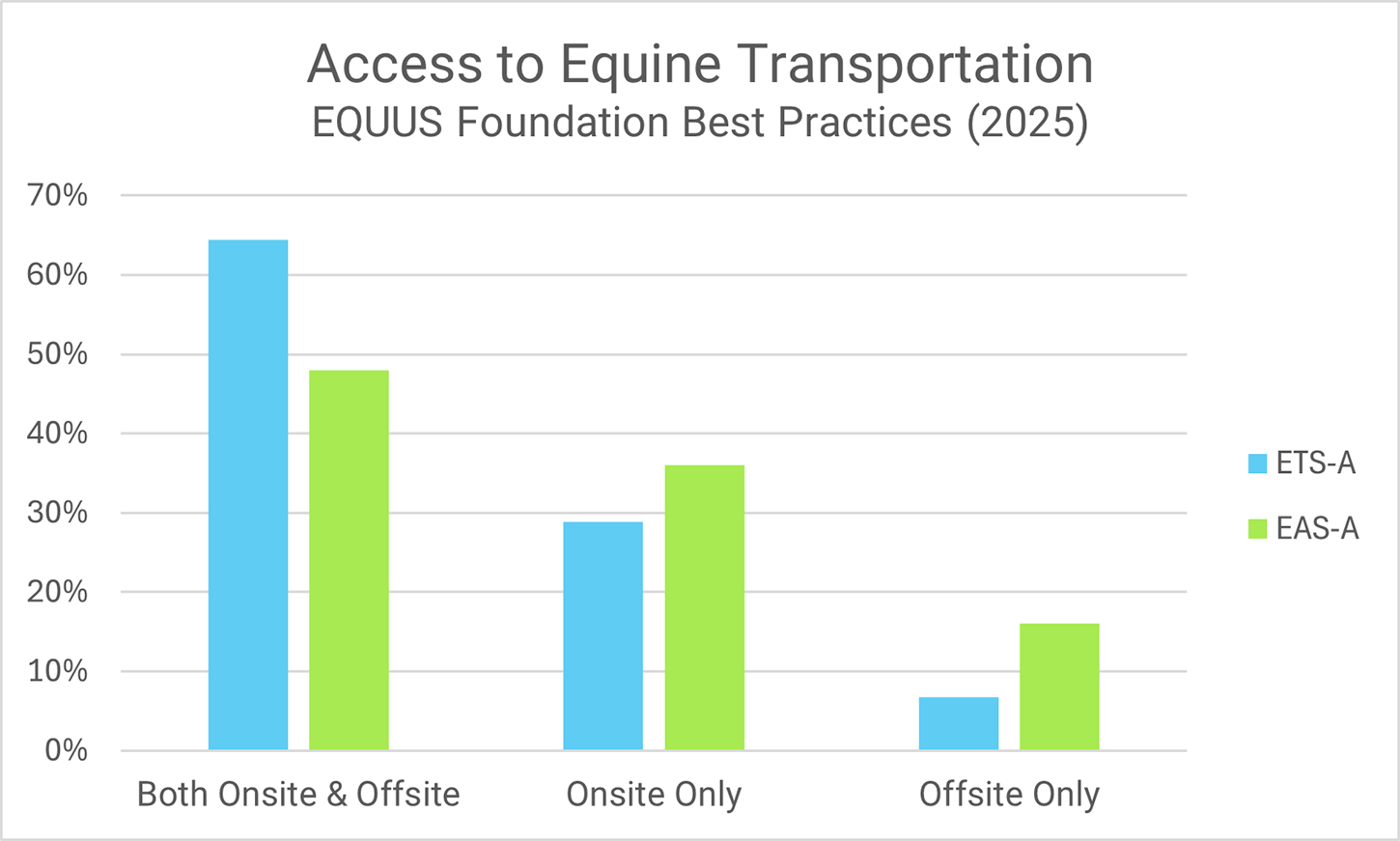
In the event of an emergency, all the charities have access to equine transportation, however, overall 13% only have access to offsite transportation based on 7% of ETS charities and 16% of EAS charities.
Close X
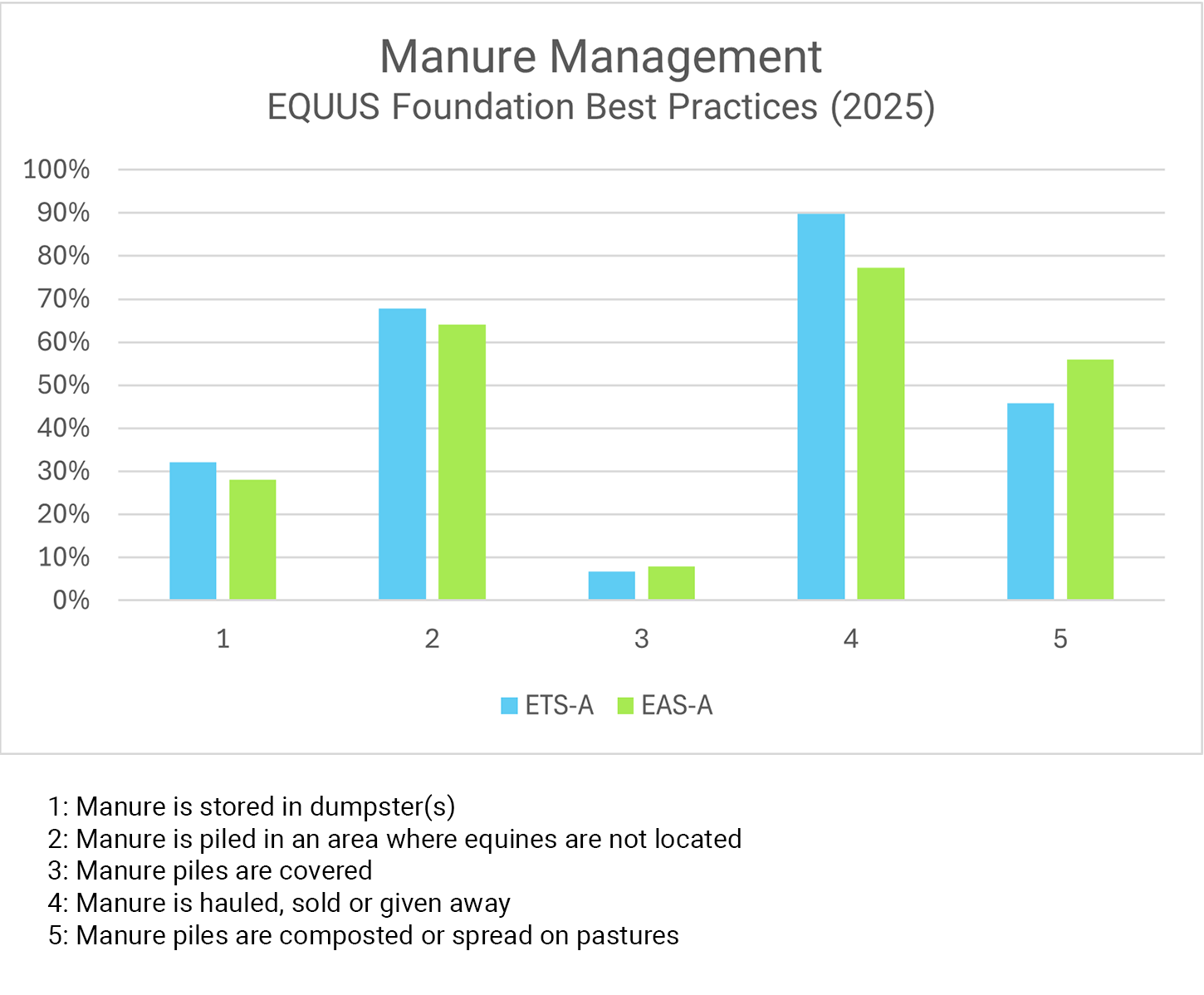
The EQUUS Foundation requires that all Guardians adhere to the manure management guidelines set by state,local authorities, and/or our organization's veterinarian.
Close X
The EQUUS Foundation requires that all Mentors follow the parasite control guidelines of our veterinarian and/or the AAEP's Internal Parasite Guidelines, including fecal testing and de-worming. Since 96% of Guardians follow the veterinarian's guidelines, going forward, all Guardians will be required to follow the veterinarian's or the AAEP's guidelines.
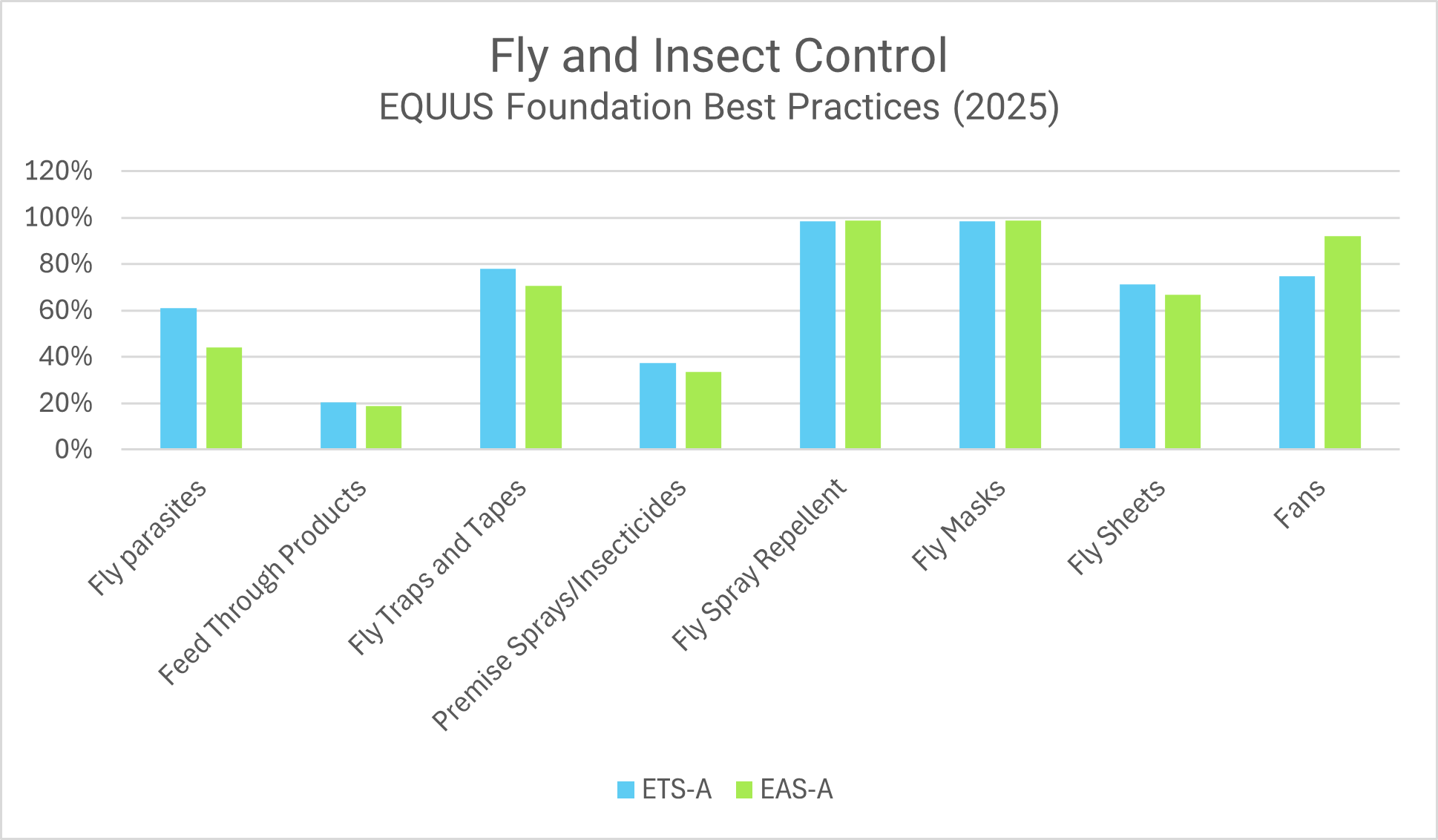
The following remedies are used to control flies and insects.
Close X
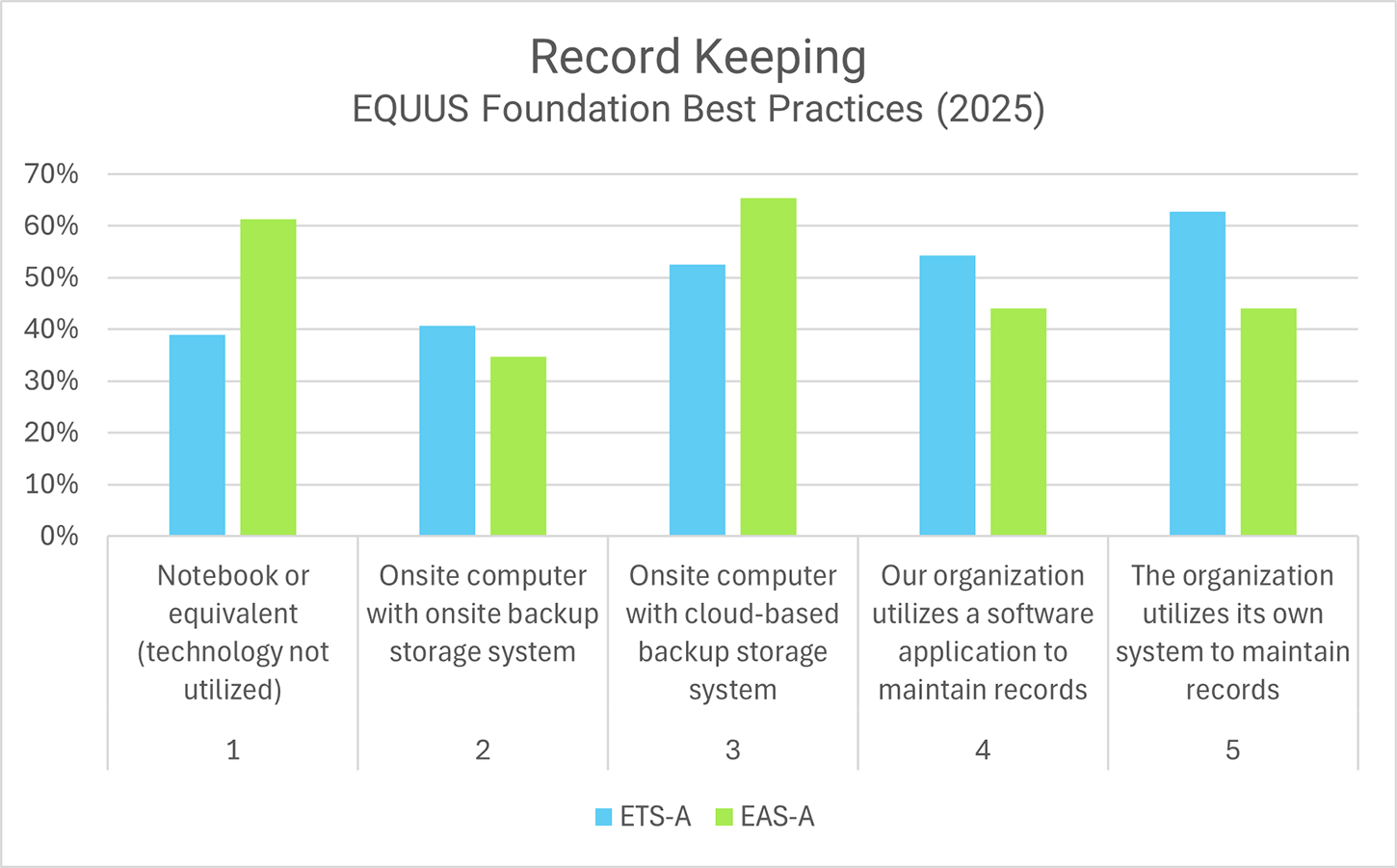
The majority of the Guardians use a combination of methods for record-keeping. Nearly 40% of the Guardians indicated that they would use free cloud-based barn management software if it were available.
Close X
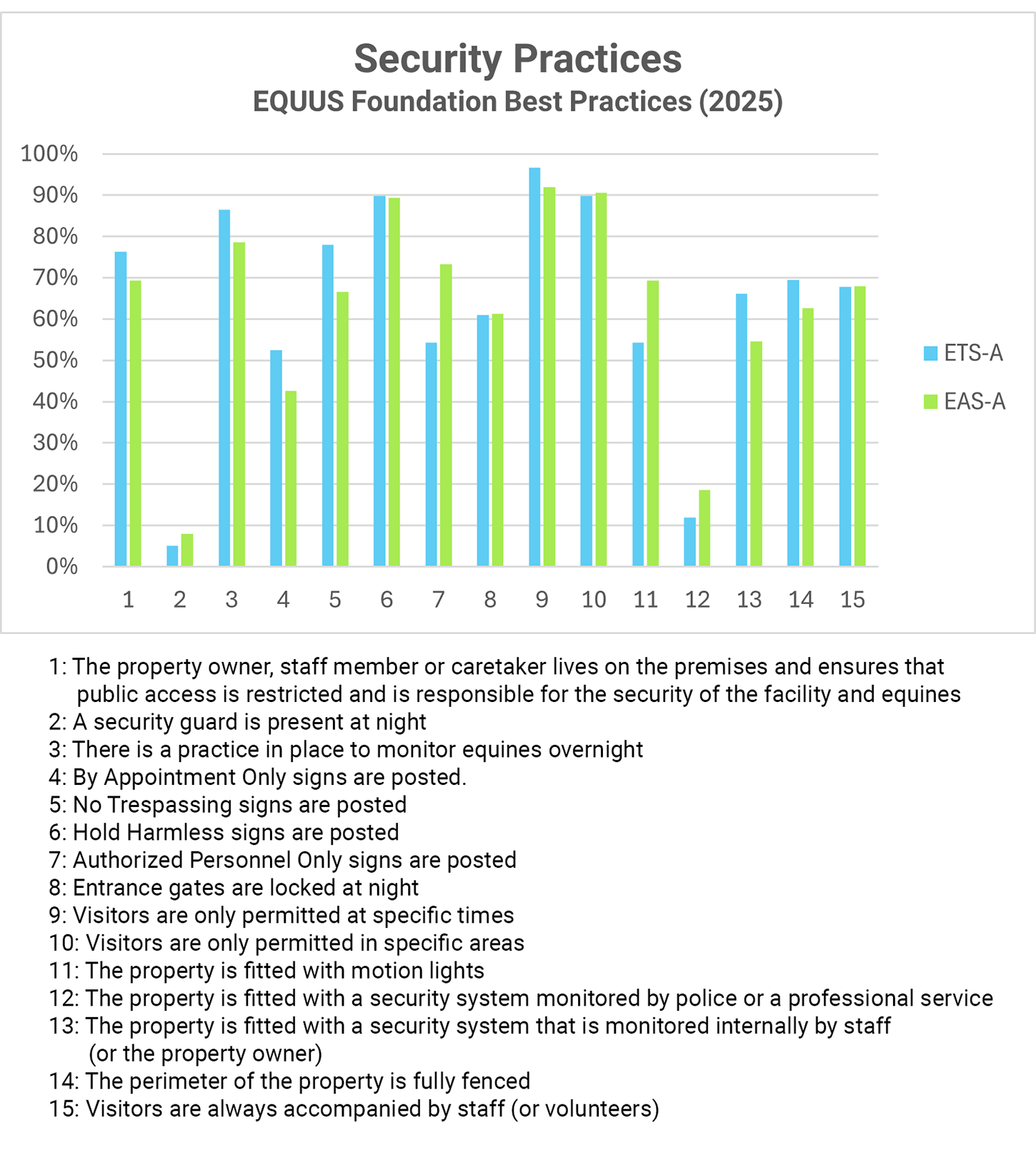
The majority of ETS and EAS charities operate with the safety security practices. Whereas less than 10% have a security guard present at night, most charities have a practice in place to monitor equines overnight.
The property owner, staff member, or caretaker lives on the premises for 76% of the ETS charities and 69% of the EAS charities.
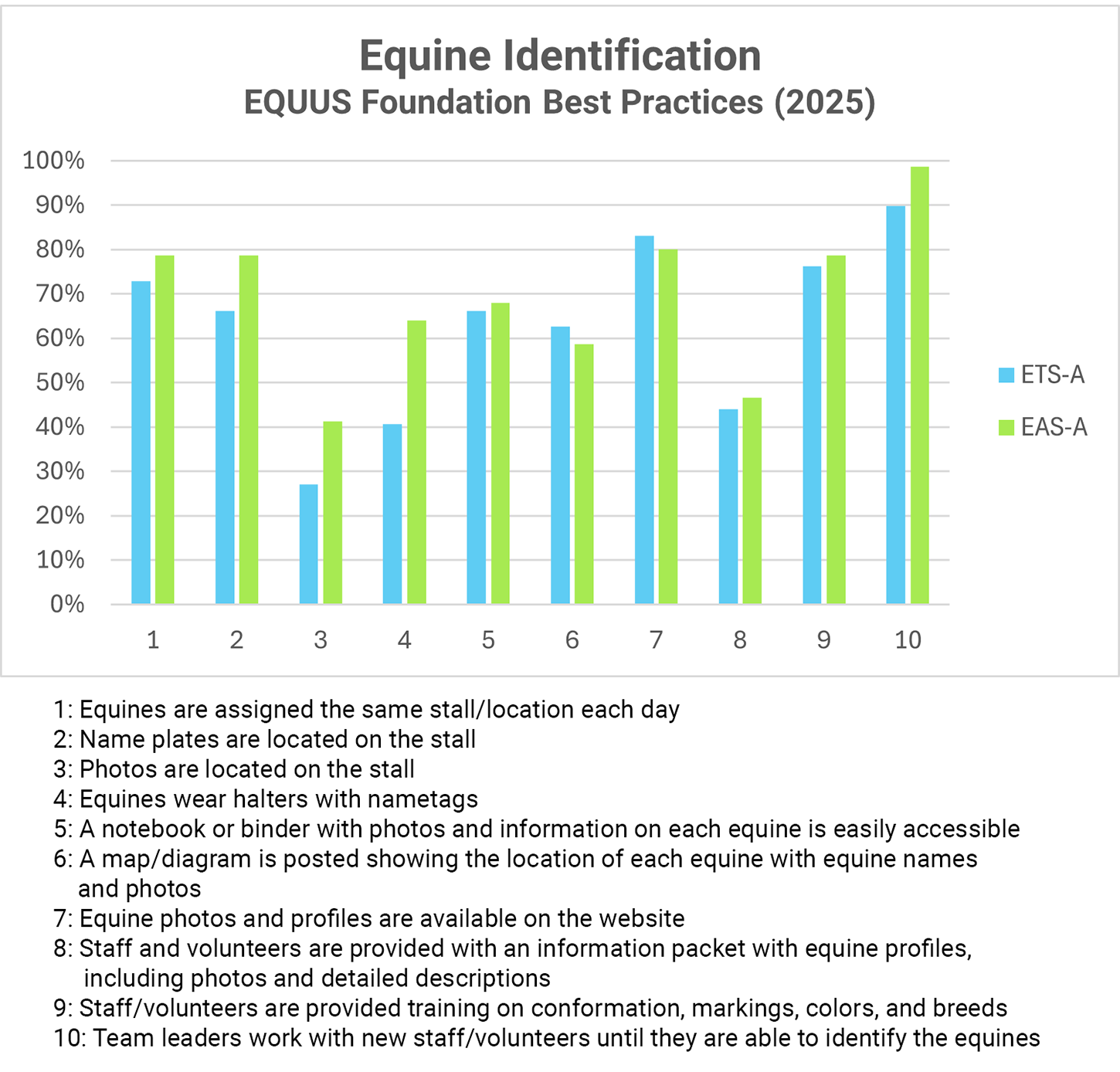
There is no appreciable difference in the practices that charities use for equine identification.
Close X
All Guardian charities must insure that:
• There is adequate lighting to ensure safety in all areas, wiring is inaccessible to equines, and electrical systems and fire prevention/protection measures (fire alarms, extinguishers and sprinkler systems) are maintained for safety.
• All the charities have fire extinguishers.
• 80% of the charities have smoke detectors.
• Only 20% of the charities have sprinkler systems.
• The organization's rules, restrictions and warnings (signage) must be conspicuously posted in easily accessible locations.
• Human and equine First Aid kits are easily accessible
All Guardian charities must operate in compliance with the following requirements:
• Equines are provided with individualized feeding plans, including supplements, according to the equine's age, breed/type, condition, size, work level and any health issues, consisting of nutritious food provided in sufficient quantity and access to adequate natural forage, or be fed daily, or as recommended by the organization's veterinarian.
• Staff and volunteers are trained in proper feed measurements and protocols and observed periodically to ensure they are feeding correctly
• The feed chart is centrally located and updated as needed
• The area(s) where hay, feed, grain, and supplements are stored are kept clean, free of debris and chemicals, and protected from weather and other animals in rodent-proof and mold-proof containers and grain bins
• Feed, supplements and hay types are clearly labeled
• Water sources, i.e., buckets, troughs, automatic waterers, etc. are kept clean, free of contaminants, ebris and chemicals, protected from weather and other animals, and be positiioned or affixed to minimize spillage
• Clean, potable water is available to each equine at all times.
--Medications are kept in a locked, climate-controlled area.
• Dental care is provided for each equine annually and when an issues arises.
• Hoof care is provided for each equine every 4-8 weeks and when an issues arises.
• Equines are visually and physically checked by personnel at the facility at least six days a week.
All Guardian charities must provide shelters for equines that:
• Have a roof and adequate ceiling & beam height (a minimum of 12" above the tip of the equine's ear) when standing
• Are kept in good repair and free of standing water, accumulated waste, sharp objects, and debris
• Provide protection from inclement weather conditions (i.e., wind, sleet, rain, snow, and temperature extremes)
• Allow equines to lie down, stand up and turn around
• Have good drainage and traction
• Have an adequate ventilation and circulation system in place to allow free flow of air to control temperature, and humidity, and to prevent air stagnation.
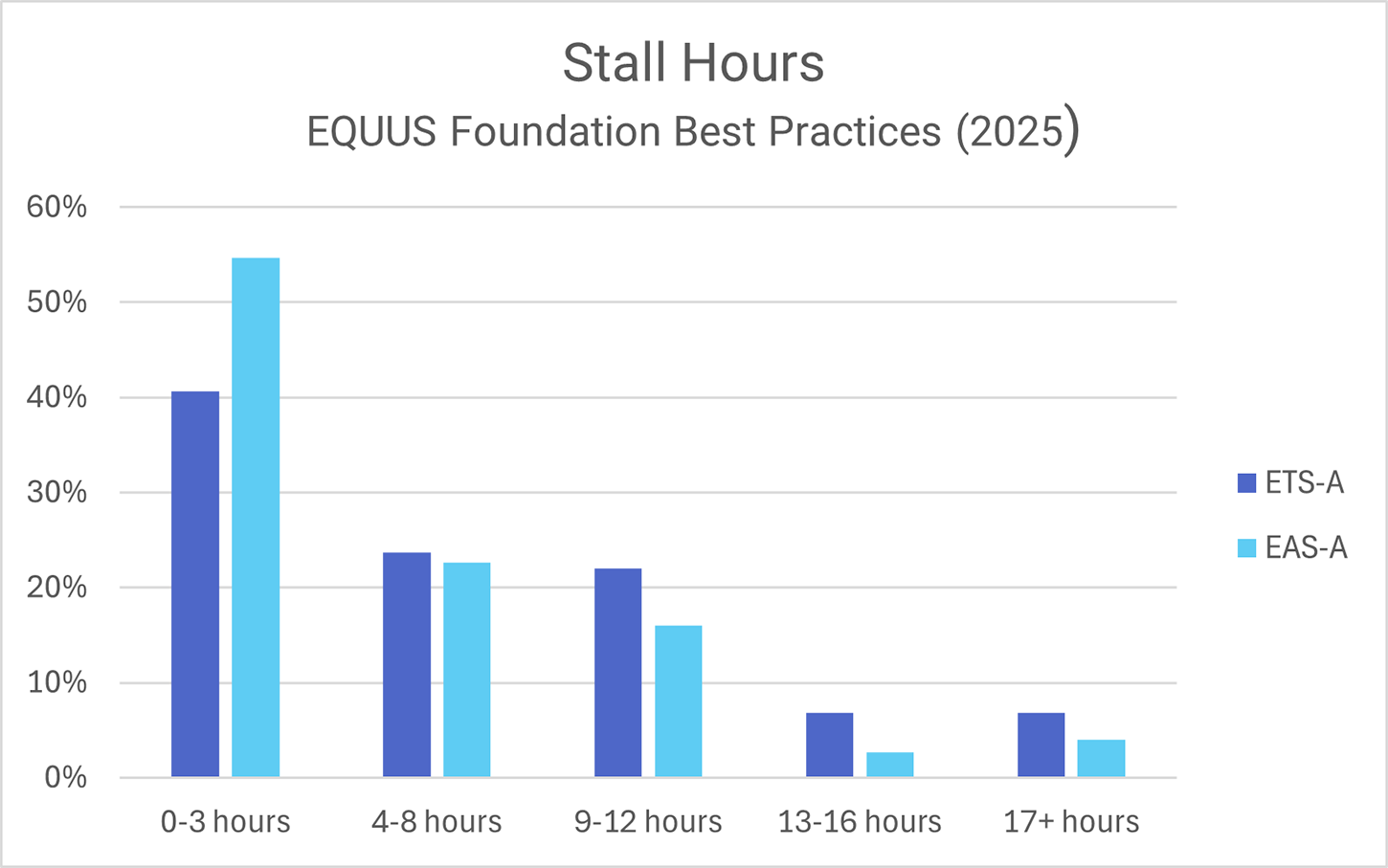
Equines have assigned stalls at 76% of ETS charities and 77% of EAS charities. The number of hours equines are stalled varies. 97% of all Guardians clean the stalls at least 6 days a week.
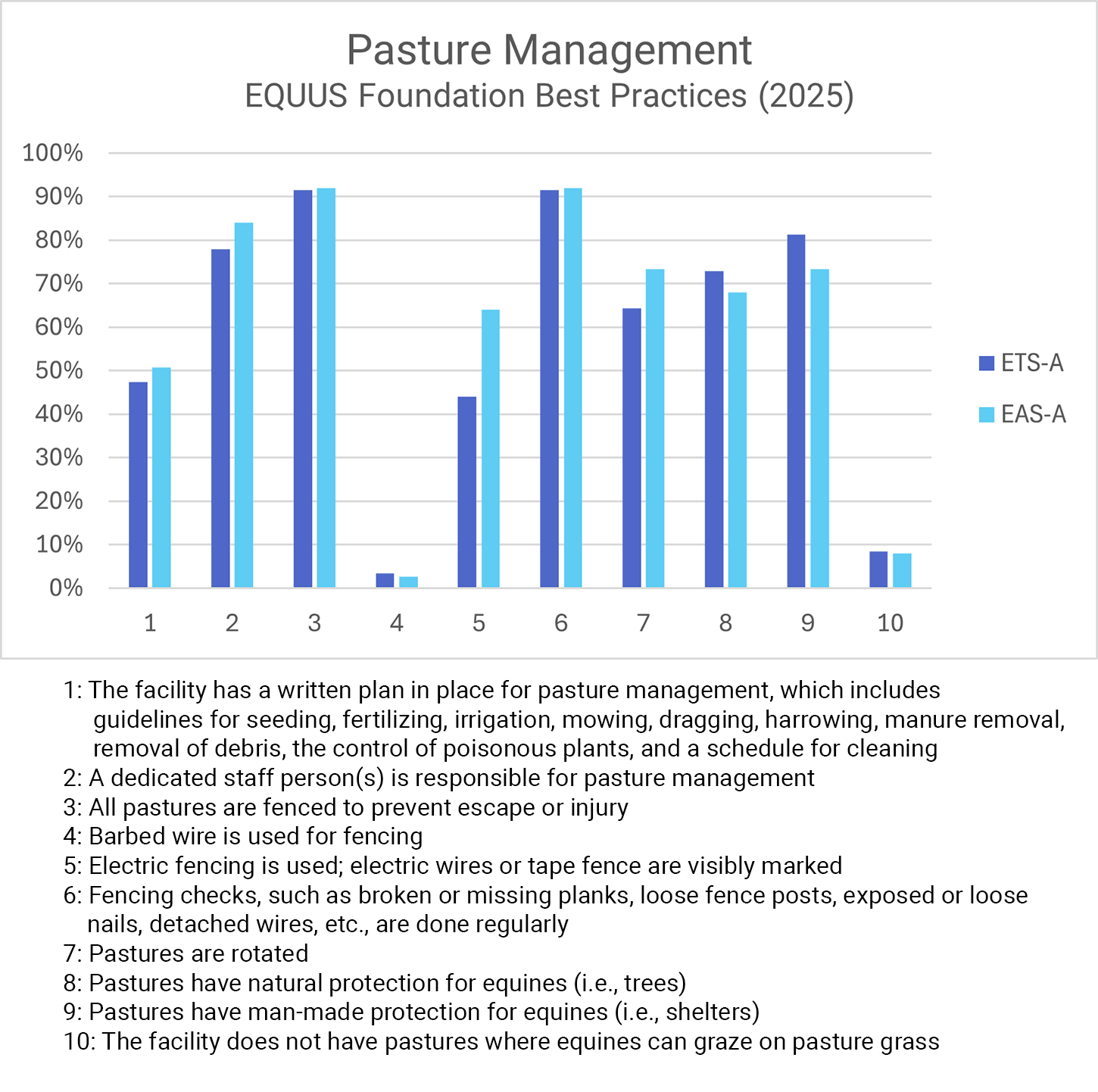
Pasture Management
ETS and EAS charities are also consistent in their pasture management practices with 8% of the charities not having pastures with grass for equines to graze.
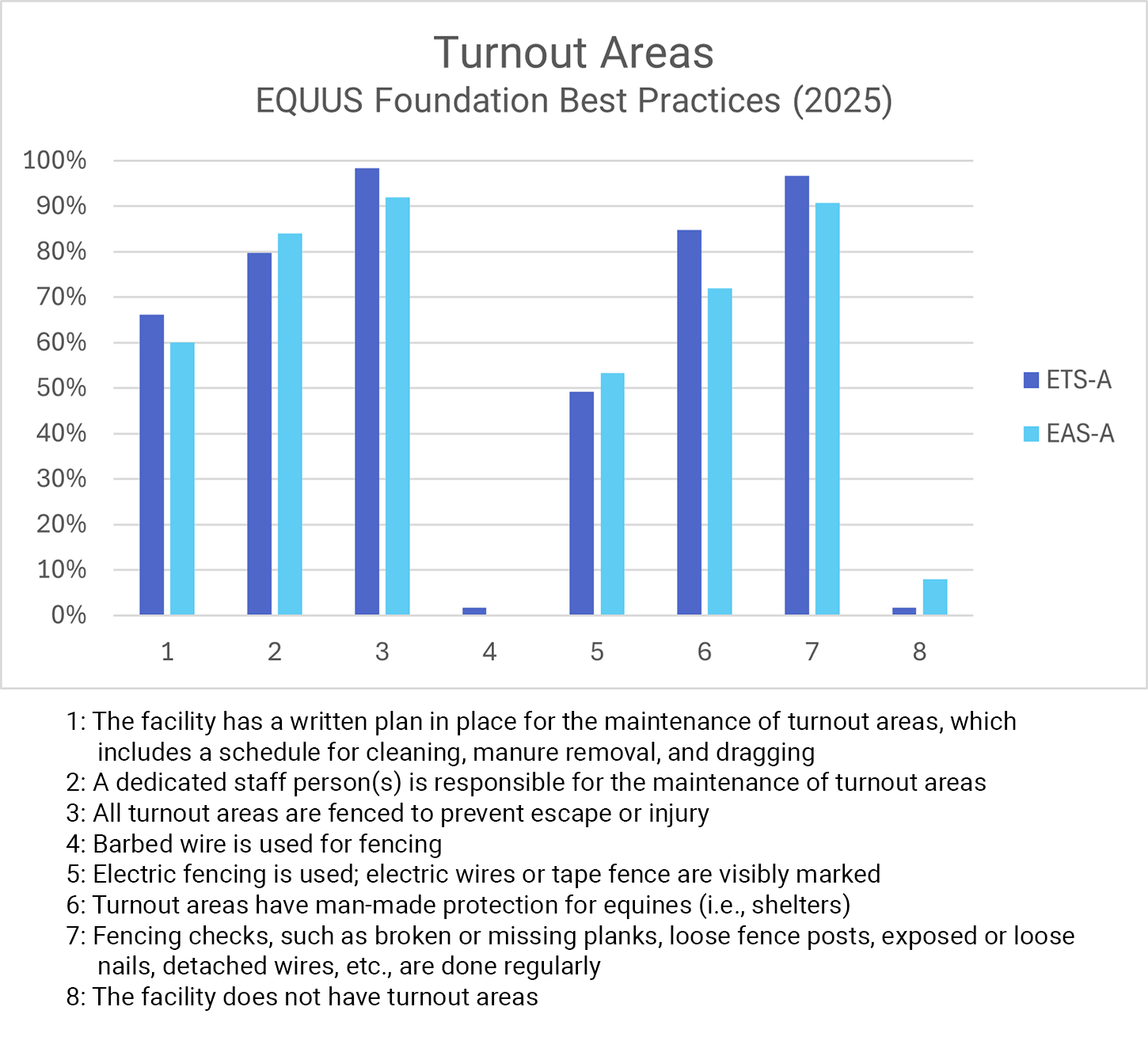
Turnout Areas
ETS and EAS charities are also consistent in their management of turnout areas. Only 2% of ETS charities vs. 8% of EAS charities do not have turnout areas. All the charities that do not have turnout areas have pastures for equines to graze.
The EQUUS Foundation requires all Mentor charities to check fencelines and turnout areas at least weekly. Of the 128 Guardian charities, 98% check fence lines and turnout areas at least weekly.
Close X
Only 27% of ETS charities and 35% of EAS charities have specifically assigned tack, apparel and equipment for their equines that is not shared.
For charities where riding is a key component, 63% of ETS and 61% of EAS charities share saddles. For bridles, there is a significant difference with 47% of ETS charities sharing bridles vs. 9% of EAS charities.
For horse apparel, the majority of both ETS and EAS charities do not share blankets, sheets or turnout aparel. Regarding halters, 39% of ETS charities share halters compared to 13% of EAS charities. Tack is cleaned after each use or at least weekly by 50% of ETS charities and 60% of EAS charities.
|
|
ABOUT EQUUS FOUNDATION: The EQUUS Foundation, a 501(c)(3) public charity established in 2002, is the only national animal welfare charity in the United States 100% dedicated to equine welfare with the dual mission to protect America's horses from peril and strengthen the bond between people and horses. Donations are tax-deductible to the full extent of the law. Contact the EQUUS Foundation, Inc., at 168 Long Lots Road, Westport, CT 06880, Tele: (203) 259-1550, E-Mail: mail@equusfoundation.org. Visit equusfoundation.org.
|
|
|
|
|